
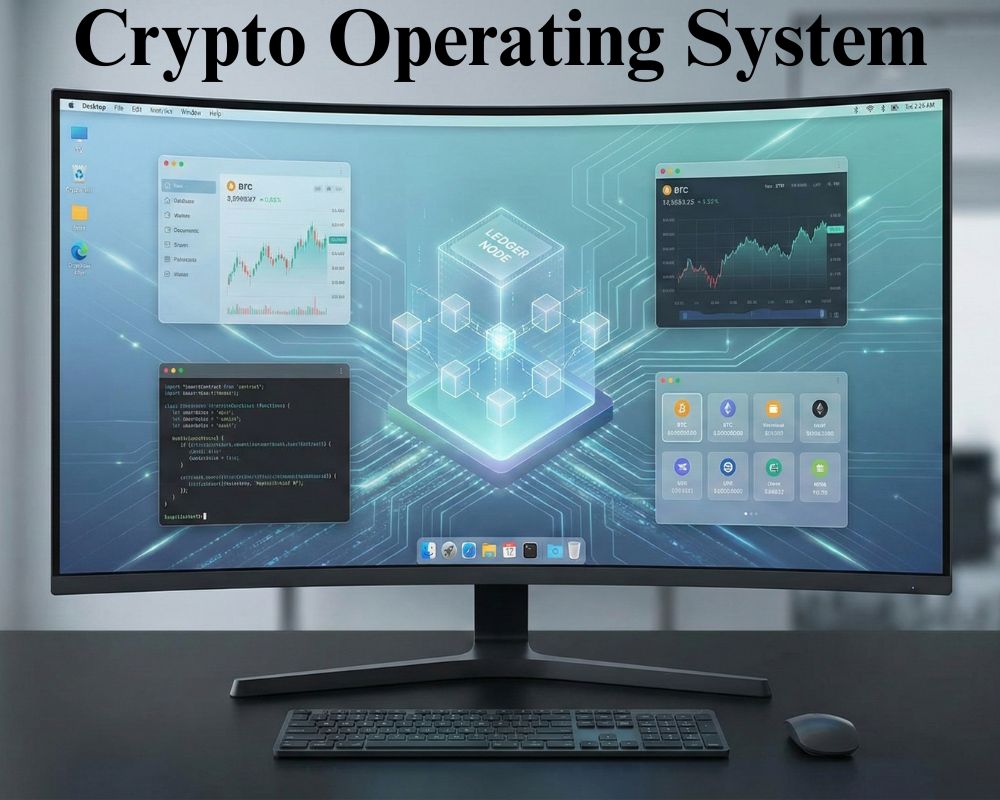

Imagine a desktop computer powered by blockchain – that’s essentially the idea behind a crypto operating system (COS). In simple terms, a crypto OS is a platform that manages cryptocurrency transactions and decentralized applications. It provides security (via cryptography), transperancy (a public ledger), and often includes tools like wallets, smart contracts and APIs all in one environment. It acts as the “backbone” for digital currency activities, enforcing strong security, decentralization and transparency. Infact, blockchain pioneers view projects like Ethereum as a “new operating system” for finance mmwarburg.de. As one industry summary explains, a crypto OS “is a platform that manages cryptocurrency transactions and applications” by leveraging blockchain for security, transparency, and efficiency lablockchainsummit.com.
For developers and crypto investors, understanding “Crypto Operating System” is more than thoretical. Large firms and startups alike are exploring this concept. For example, Coinbase has even dubbed its new crypto business account a “crypto operating system” for small businesses. Similarly, Ripple’s president Monica Long recently announced plans to position Ripple’s network “as the default operating system for institutional crypto use cases” coindcx.com. These moves show the term isn’t just hype – it reflects a real vision of blockchain as a comprehensive platform, not just a ledger or a currency.
Key Features of a Crypto Operating System
Crypto operating systems pack features that go beyond regular wallets. They typically offer:
- Robust Security: COSs use advanced encryption and multi-factor authentication to protect assets. As one expert notes, they provide “strong security measures… to ensure that only authorized users can access and manage cryptocurrency transactions” lablockchainsummit.com. This means your private keys and funds stay safe from hackers and theft.
- Decentralization: Unlike a single computer or server controlled by one entity, a crypto OS runs on a decentralized network. Control is spread across many nodes, so no single point of failure or manipulation exists lablockchainsummit.com. This built-in decentralization greatly reduces fraud risk and downtime.
- Transparency: Every action is recorded on an immutable ledger. In practice, this means all transactions and commands a user makes through the COS are logged publicly lablockchainsummit.com. This blockchain-based record-keeping ensures full visibility and auditability (for example, IBM’s Food Trust tracks every step of a product’s journey to guarantee quality lablockchainsummit.com).
- Interoperability and Smart Contracts: Many crypto OS platforms integrate smart-contract support and cross-chain bridges. They aim to let different blockchains and apps interconnect smoothly, enabling features like automated contracts or multi-chain asset swaps. (Think of an OS that runs decentralized apps seamlessly on top of its ledger.)
These features together make a crypto OS more like a full computing environment for blockchain apps, rather than just a wallet. For instance, 10Clouds observes that “a blockchain operating system works a lot like a regular operating system”, serving as a layer where all user commands and transactions are handled and recorded 10clouds.com.
Crypto Operating System vs Traditional System
A cryprto operating system has similarities with familiar OSes (like Windows or Android), but also key differences. Like a regular OS, a crypto OS provides an interface and system services beneath the applications. It handles user input, connects to hardware (the blockchain network) and runs background tasks. The main difference is the environment: a crypto operating system runs a blockchain network rather than on your local CPU. It records every “command” (transaction or action) on-chain, providing unmatched transparency.
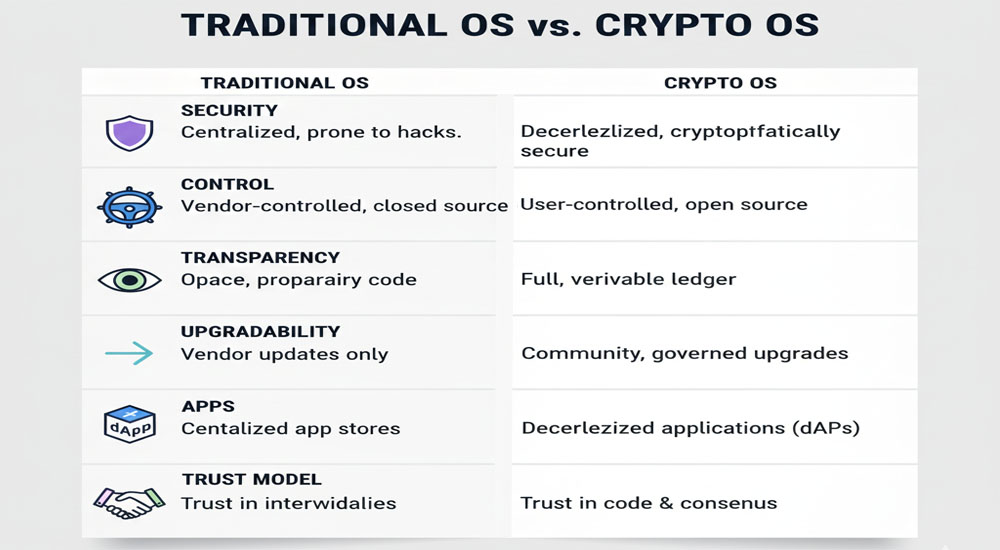
Compared to traditional software wallets or exchanges, a crypto OS is far more comprehensive. A wallet typically only stores keys and sends/receives coins. A crypto OS, by contrast, might integrate trading, staking, messaging, identity and more in one platform. For users this means having a unified hub where they can manage assets, run decentralized apps (dApps), and even handle compliance – all with the same account. Essentially, it replaces siloed tools with one coherent system.
In short, think of a crypto Operating System as a smartphone running on blockchain. It delivers a graphical interface and apps (dApps) powered by smart contracts. It makes blockchain functions user-friendly. As noted above, one developer explained that a blockchain OS “adds a layer below the software to make it easier for the software to talk to the hardware”, and logs every transaction on the chain10clouds.com. This extra layer abstracts away much of the complexity, similar to how iOS or Android abstracts hardware details for mobile apps.
Popular Crypto Operating systems
Several blockchain projects and platforms are positioning themselves as crypto operating systems or providing similar ecosystems:
- Ethereum (Ethereum OS): Often called the “world computer” or the new operating system of digital finance mmwarburg.de, Ethereum pioneered smart contracts. Its Ethereum Virtual Machine (EVM) lets developers deploy decentralized applications that run without downtime. For example, Uniswap (a decentralized exchange) runs entirely on Ethereum, allowing peer-to-peer trading without a central broker lablockchainsummit.com. Many consider Ethereum the template for a crypto OS.
- Holochain: The Holochain whitepaper boldly declares “Holochain is a crypto-operating system” letterfluff.dev.holo.host. It isn’t a blockchain but a network of agent-centric chains. In Holochain, each user maintains a personal data chain that syncs via a distributed hash table. This design aims to scale peer-to-peer apps enormously without massive consensus overhead. By calling itself an OS, Holochain highlights that developers can build apps in a familiar way (like coding for an OS), but with cryptographic integrity under the hood.
- Ripple (XRPL): While XRP Ledger is known for payments, Ripple’s team is framing XRPL as an institutional crypto OS. At Ripple Swell 2025, Monica Long said Ripple’s strategy is to be the “default operating system for institutional crypto use-cases” coindcx.com. Essentially, Ripple aims to provide banks and firms with everything they need on-chain: cross-border payments, stablecoin issuance, on-demand liquidity and custody, all under one platform.
- Coinbase Crypto OS (Business Account): Coinbase now offers a crypto-native business account that combines payments, custody, yields and conversions with no incoming transaction fees. Coinbase describes this service as a “crypto operating system” for startups and small businesses pymnts.com. It signals how exchanges are moving toward full-stack crypto platforms, not just simple wallets.
- Crypto OS (by Nick Spanos): Industry veteran Nick Spanos (Bitcoin Center NYC founder) has long talked about a project dubbed “Crypto OS.” It promises an integrated Windows-like environment for cryptocurrency, uniting wallets, DeFi apps and data feeds under a graphical interface. While still under development, its concept shows the direction: one expert interview noted Spanos “made Crypto OS” and is working to bring it to reality 10clouds.com.
Each of these examples illustrates the crypto OS idea. A unified, secure blockchain-based platform for diverse digital finance tasks. The details vary (some focus on trading, others on enterprise finance or IoT), but all share the goal of making blockchain powerful and user-friendly
Benefits and Real-World applications
Crypto operating systems unlock advantages that appeal to both tech builders and investors. Security is chief among them, because operations are cryptographically protected and logged, usrs enjoy “enhanced security features” that give them peace of mind. For developers, COS platforms offer flexibility and scalability. They can deploy applications without a single administrator or gatekeeper, reducing downtime risks lablockchainsummit.com.
In practice, this power translates to many use cases:
- Finance and Payments: Crypto OS platforms are ideal for cross-border transfers, tokenized assets, and banking services. Ripple, for instance, envisions banks using XRPL’s OS capabilities (like on-demand liquidity) to settle payments instantly. Similarly, enterprises can issue stablecoins or programmable bonds on these systems. Indeed, traditional finance players have invested billions into Ethereum-based projects for automated trading, lending protocols, and more – treating it as a financial operating system mmwarburg.de.
- Supply Chains: Blockchains as OS bring transparency to logistics. For example, IBM’s Food Trust is a blockchain platform (a kind of supply-chain OS) that tracks food from farm to table. Every handoff is recorded immutably, ensuring product authenticity and safety lablockchainsummit.com. A true COS can generalize this: any company can build an app to trace goods, compliance paperwork or provenance on a shared ledger.
- Data Security and Identity: Healthcare, insurance, and government services benefit from blockchain OS’s security. Hospitals could store patient records on a secure ledger rather than vulnerable databases. Cities might issue digital IDs or deeds that individuals fully control. The decentralized OS model ensures data integrity and user privacy – an attractive upgrade over traditional databases.
- Developer Ecosystems: By providing common standards and tools (much like Android’s SDK or iOS’s Xcode), COS environments encourage innovation. For instance, if Ethereum is the OS, then tools like MetaMask or Truffle are its app development kits. This accelerates the creation of new dApps, from games to DeFi protocols, without rebuilding blockchain fundamentals each time.
- Startup Enablement: New projects can bootstrap on existing crypto OS networks instead of building blockchains from scratch. This lowers costs and time-to-market. Coinbase’s OS-like business account lets startups onboard crypto easier; similarly, decentralized identity OSes (like uPort on Ethereum) let businesses plug into identity systems without building them.
Overall crypto operating systems promise efficiency and trust. They automate processes via smart contarcts (removing intermediaries) and record everything on a temper-proof ledger. For example, Uniswap on Ethereum allows trades to happen peer-to-peer without any central brokerlablockchainsummit.com. These benefits help businesses save on fees and spend up transactions, while giving investors confidence in the system’s robustness.
Conclusion
Crypto operating systems are the frontier of blockchain innovation. They blur the line between software platforms and decentraloized networks, offering a new paradigm for running digital finance. By combining multiple crypto services into one framework, COS platforms can make blockchain tech more accessible, secure, and versatile for everyone – from crypto-savvy developers to everyday investors.
What do you think about thid trend? Have you used any blockchain apps that feel like an OS? Share your thoughts below and join the conversation. For more insights on crypto platforms and projects, check out our related articles and consider subscribing to our newsletter for updates on the latest in blockchain technology.