

In the world of crypto, Decentralized Autonomous Organization (DAO) are emerging as a new kind of corporate structure. Imagine a company without a CEO, run entirely by code and community votes chainalysis.com. DAOs harness blockchain technology to decentralize control: they are blockchain-based communities designed to bring a more open, democratic management structure chainalysis.com. Unlike traditional firms, a DAO has no central leadership; instead, smart contracts encode the rules and decision-making logic on a blockchain en.wikipedia.org. Anyone holding the DAO’s crypto token can propose changes and vote, so governance is shared globally.
What Are Decentralized Autonomous Organization (DAO)?
At its core, a DAO is an organization governed by software—smart contracts that define its rules. Think of it as a trustless, global co-op on the blockchain en.wikipedia.org. For example, a famous DAO on Ethereum raised $150 million in 2016 to fund projects via transparent community voting, only to be exploited for $50 million by hackers due to a code flaw. In essence, a DAO is like a self-executing company: there’s no CEO, and all transactions (like spending or rule changes) are recorded on-chain en.wikipedia.org.
When a DAO is formed, the founders typically create a governance token. This “DAO crypto” token represents membership and voting power chainalysis.com. Token-holders might include investors, founders, or community contributors. Owning tokens often means “one token = one vote,” though some DAOs set minimum token-hold thresholds for proposals chainalysis.com. Crucially, everything is transparent: the blockchain shows the DAO’s treasury balance, past votes, and changes to the smart contract. Members can audit these records anytime, which builds trust in the organization.
How Do Decentralized Autonomous Organization (DAO) Work?
Decentralized Autonomous Organization (DAO) use smart contracts (self-executing blockchain code) to automate operations chainalysis.com. When you join a DAO, you install its token in your digital wallet. You can then participate in governance by submitting proposals or voting. The typical DAO process is:
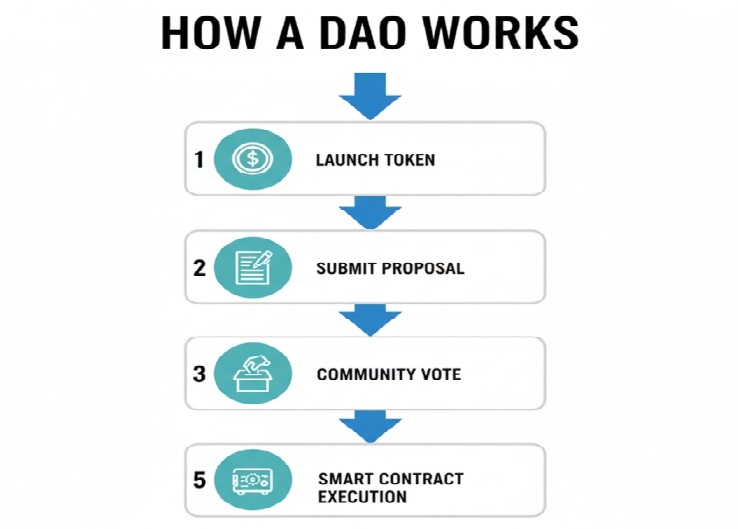
- Proposal Submission: Any member can post a proposal (for example, to allocate funds, change a protocol parameter, or start a new project) on an open forum or DAO platform. This could be on the DAO’s website, a messaging channel, or a governance portal.
- Voting: After discussion, the proposal goes to a vote. Members lock (stake) their DAO tokens and cast votes. Depending on the rules, proposals may need a minimum quorum of votes or a certain percentage approval to pass. Votes are often weighted by token holdings (so one large token-holder can wield more influence). Chainalysis notes that in practice, “less than 1% of all holders have 90% of the voting power” in many DAOs chainalysis.com, so DAOs are exploring mechanisms (like quadratic voting) to avoid domination by a few whales.
- Execution: If the vote meets the criteria, the smart contract automatically enacts the decision chainalysis.com. For example, the DAO’s treasury (often holding ETH or stablecoins) might release funds to a project, or a protocol parameter might be updated on the blockchain. Because this is all done on-chain, the outcome is irreversible and transparent to all.
Decentralized Autonomous Organization (DAO) also raise funds through their tokens. Typically, a DAO mints and sells governance tokens to investors during launch chainalysis.com. The money raised becomes the DAO’s treasury. In effect, buying a DAO token is like buying a share in the organization. Anyone can purchase these tokens on cryptocurrency exchanges later, allowing new members to join by buying in. The combination of token sales and smart contracts lets DAOs function like decentralized venture funds, co-ops, or clubs without relying on a centralized company structure.
Many DAOs use specialized platforms (Aragon, DAOstack, Snapshot, etc.) to handle voting and treasury management, making it easy for even non-developers to create or join a DAO. Essentially, DAOs are distributed apps where the “board members” are token-holders, and the “company bylaws” are written in code chainalysis.com.
DAO Crypto Tokens and Governance
The term DAO crypto refers to the governance tokens of a DAO. These tokens have market value and also grant governance rights. For instance, MakerDAO’s MKR token lets holders vote on the interest rates and collateral rules for the DAI stablecoin system. Apecoin (APE) holders govern the Ape Foundation’s NFT and metaverse projects. Holding the token often also entitles you to a share of fees or profits. For example, some DAOs distribute protocol revenues or rewards back to token-holders, aligning economic incentives with governance.
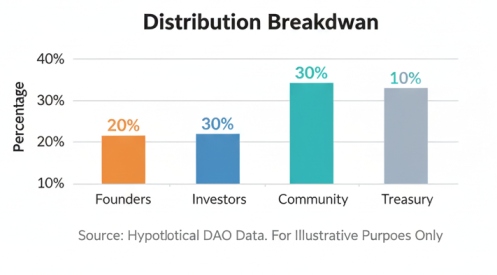
DAO tokens are usually distributed at launch, but they can also be earned (e.g. by contributing code or services). Once in circulation, they are traded like any cryptocurrency. The liquidity of DAO tokens means ownership can change hands easily, making the DAO’s makeup dynamic.
Popular DAO tokens include UNI (Uniswap), LDO (Lido), AAVE (Aave), SNX (Synthetix), and many others. When Uniswap launched its DAO, it distributed UNI tokens to past users of the exchange chainalysis.com. Those UNI holders now vote on Uniswap’s development path. In this way, DAO crypto blurs the line between currency and corporate share: it’s both an asset you can trade and a vote in a digital co-operative.
Decentralized Governance: Power to the People
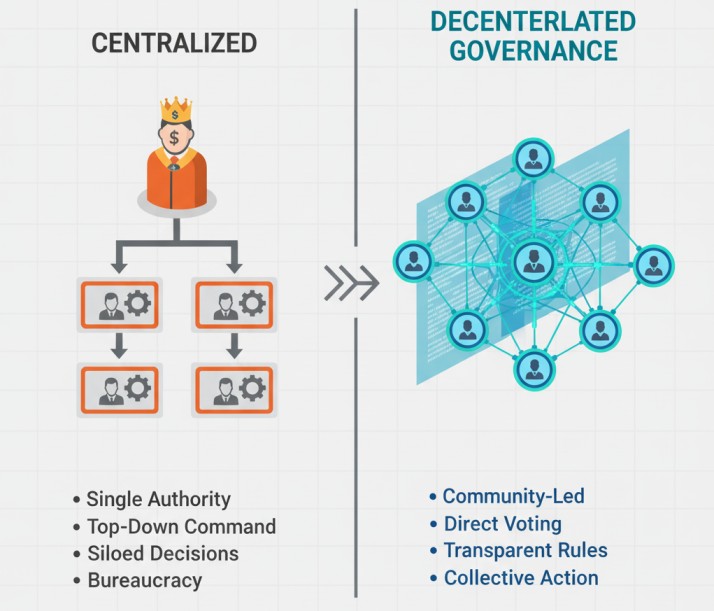
Centralized vs Decentralized: Traditional organizations concentrate decision-making at the top (a CEO or board). The DAO’s structure, decentralized governance, spreads power across all token-holders. In an ideal DAO, a single governance token and an internet connection allow individuals anywhere in the world… to work together.” chainalysis.com. Because the blockchain records votes, anyone can verify the process, which increases trust and accountability.
However, real-world DAOs aren’t perfectly egalitarian. Chainalysis found that often a few whales hold most voting power chainalysis.com, which can undermine decentralization. Some DAOs introduce rules (such as vote caps or quadratic voting) to limit this effect en.wikipedia.org. The goal is to let the community drive decisions rather than a single leader. In practice, achieving true decentralization requires active participation: if only a handful of people vote, the outcome reflects just that minority.
DAOs illustrate a new model of governance. The figure above compares a centralized system (left) with a decentralized network (right). In a decentralized governance model, authority radiates from every node (member) rather than coming from a single point. This structure can be more resilient and inclusive, but it also demands coordination. As one expert notes, the key is not choosing between decentralization and hierarchy but balancing them so that community-driven innovation can thrive while keeping the project sustainable coindesk.com.
Benefits of Decentralized Autonomous Organization (DAO)
DAOs offer unique advantages over traditional organizations:
- Global & Inclusive: Anyone, anywhere can join if they hold the token. This opens participation to a global pool of contributors and investors, from developers in one country to artists in another. You don’t need special credentials – just an internet connection and a crypto wallet chainalysis.com.
- Transparency: All DAO rules and finances live on the public blockchain. Members can audit the smart contract code and all transaction history at any time. This visibility helps prevent fraud and builds trust, since everything from fund transfers to vote tallies is verifiable chainalysis.com.
- Community Ownership: DAO members jointly own and govern the project. Stakeholders are directly “in the driver’s seat,” aligning incentives. As Chainalysis observes, because votes are on-chain, “everyone is more personally invested in the DAO’s success.” chainalysis.com. This sense of ownership can motivate participants to work in the DAO’s best interest.
- Efficiency via Automation: Smart contracts automate many processes: they pay out rewards, adjust parameters, or unlock funds once goals are met. This reduces bureaucracy and removes middlemen. For example, a DAO can automatically distribute grant funds once a proposal passes, without a manager signing any paperwork.
- Innovation & Experimentation: DAOs enable rapid collective action. For instance, ConstitutionDAO became a real-world test of the model: over 17,000 people pooled $47M in a week to bid on a rare document via a DAO chainalysis.com (though they narrowly lost the auction). Such fundraising and coordination would be impossible in a traditional setting. DAOs allow communities to self-organize around niche interests—whether that’s funding art, rescuing pets, or investing in new tech—without waiting for permission from centralized authorities.
Challenges and Risks of Decentralized Autonomous Organization (DAO)
DAOs are still a new concept, and several challenges remain:
- Smart Contract Vulnerabilities: Because DAOs rely on code, bugs can be disastrous. The 2016 DAO hack is the most famous example: a flaw in the smart contract allowed an attacker to drain about $50M of ETH en.wikipedia.org. Since then, audits and caution have improved, but the risk never fully goes away.
- Power Concentration: Token-based voting can replicate plutocracy. Large token-holders can dominate decisions, and newcomers have less say. Chainalysis notes that often “less than 1% of holders control 90% of voting power.” chainalysis.com. DAO designers are experimenting with solutions like quadratic voting or vote escrow to spread influence more evenly.
- Participation & Governance: If most members don’t vote or engage, a small core group ends up running the show. Ensuring broad participation is hard—similar to how many people skip shareholder votes or town hall meetings. Low turnout can lead to proposals passing that only a few people wanted.
- Coordination & Speed: Reaching consensus among a large group can be slow. Time-sensitive decisions (like responding to an exploit) may suffer from long voting delays. Some DAOs keep emergency multisig wallets off-chain for quick reactions, but that adds a degree of centralization.
- Legal Uncertainty: Many countries lack clear laws for DAOs. Is a DAO a partnership, a nonprofit, or something entirely new? This ambiguity makes it hard to enter contracts, hire employees, or guarantee liability protections. Some DAOs incorporate in favorable jurisdictions or form LLCs to navigate this. Notably, U.S. states like Utah have passed laws recognizing DAOs as LLCs chainalysis.com, which helps, but global regulation is still catching up.
- Economic Risks: Because DAO tokens are traded on crypto markets, their value can be volatile. A sudden price drop could concentrate power differently. Also, if the DAO’s treasury loses value, the organization might lack funds to function.
Despite these risks, the DAO ecosystem is rapidly learning and adapting. Many prominent DAOs have implemented safeguards. For example, some require quorum thresholds or multi-signature approvals for major changes. The key is to combine the ideals of decentralization with practical checks—something experts argue is the future balance coindesk.com.
Real-World DAO Examples
Several high-profile DAOs illustrate how this model works in practice:
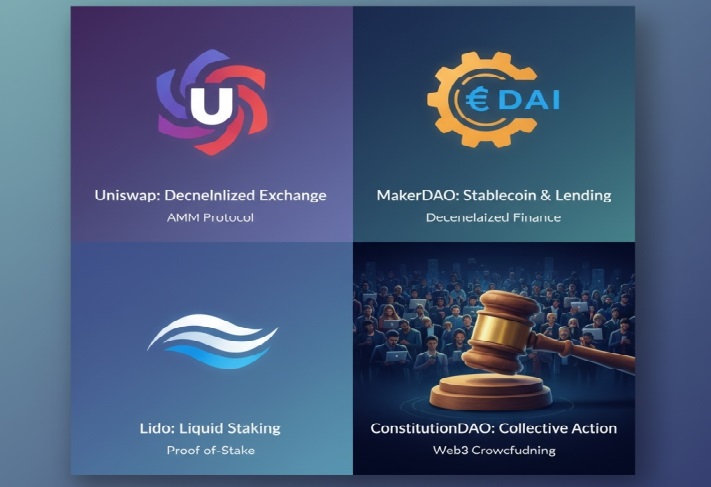
- Uniswap Foundation (UNI): Governs Uniswap, the world’s largest decentralized exchange. UNI token-holders vote on protocol upgrades and how to allocate the foundation’s treasury chainalysis.com.
- Lido DAO (LDO): Manages Lido, a liquid staking protocol for Ethereum. LDO holders decide on budgets, rewards, and which entities run validators.
- MakerDAO (MKR): Runs the DAI stablecoin system. MKR voters set key parameters like stability fees and debt ceilings. (MakerDAO has even rebranded to “Maker”/“Sky,” showing how DAOs evolve over time.)
- Aave (AAVE): A lending platform where AAVE token-holders govern interest rates and new feature proposals.
- BitDAO (BIT): A pooled investment fund for Web3, backed by major firms (e.g. Peter Thiel’s VC). BIT holders vote on funding grants to blockchain projects.
- Ape Foundation (APE): Supports NFT and community projects. APE token holders decide on grants and ecosystem development.
- ConstitutionDAO: A temporary DAO formed in 2021 to bid on an original U.S. Constitution. It rallied tens of thousands of people and $47M, demonstrating the model’s rallying power chainalysis.com, although it ultimately didn’t win the auction.
- Niche DAOs: There are DAOs for all sorts of purposes – NFT collectors, writing groups, social clubs, charity funds, and more. Each operates on the same core principles of token-based governance.
Chainalysis reports that the top DAOs by governance-token market cap (as of 2023) are Uniswap, Lido, Ape Foundation, Arbitrum, Internet Computer, Aave, BitDAO, Curve, Synthetix, and Maker chainalysis.com. These span decentralized exchanges, staking, infrastructure, and DeFi – showing DAOs’ broad applicability.
A Snapshot of Leading DAOs
| DAO (Project) | Token | Market Cap | Focus |
|---|---|---|---|
| Uniswap (DEX) | UNI | $3.4B | Decentralized exchange |
| Lido (Ethereum staking) | LDO | $2.1B | Liquid staking protocol |
| Ape Foundation (NFT/Metaverse) | APE | $1.5B | Community-led art, gaming, metaverse |
| Arbitrum (Layer 2) | ARB | $1.5B | Ethereum Layer-2 scaling |
| Internet Computer (Blockchain) | ICP | $1.4B | Web3 infrastructure blockchain |
| Aave (Lending) | AAVE | $1.0B | Crypto lending protocol |
| BitDAO (Funding) | BIT | $1.0B | Web3 project treasury |
| Curve (Stable DEX) | CRV | $778M | Automated stablecoin trading (AMM) |
| Synthetix (Derivatives) | SNX | $691M | Synthetic asset derivatives protocol |
| MakerDAO (Stablecoin) | MKR | $677M | Algorithmic stablecoin (DAI) platform |
Source: Chainalysis chainalysis.com (market caps as of 2023)
These examples show DAOs in action: communities running platforms, pooling funds, and making decisions without a traditional hierarchy.
The Future of DAOs and Decentralized Governance
Decentralized Autonomous Organization (DAO) are rapidly evolving. Tools and services around them are improving, platforms like Aragon or DAOhaus make it easier to launch a DAO with no coding, and governance tools (e.g. Snapshot, Tally) streamline voting. Even governments are taking note: Utah’s 2024 Decentralized Autonomous Organization Act officially recognizes DAOs as LLCs under the law chainalysis.com, giving them a clear legal status. New Hampshire and other jurisdictions are considering similar steps.
However, many experts emphasize that DAOs won’t remain purely chaotic experiments. As attorney Kurt Watkins notes, purely decentralized governance often gives way to more structured models for long-term viability coindesk.com. He argues the key is not choosing between decentralization and traditional hierarchy, but finding a balance that “empowers community-driven innovation while ensuring the project can scale, remain compliant, and operate sustainably.” For instance, MakerDAO’s own experience shows how highly decentralized ideals can centralize over time – after a recent protocol vote, a small group wielded outsized influence, illustrating the limits of naive decentralization coindesk.com.
Looking ahead, DAOs could reshape organizations beyond crypto. Imagine companies where every employee or stakeholder holds a token to vote on policies, or investment clubs where members all have a say in fund allocation. Tech enthusiasts speculate that DAOs might run everything from social networks to public goods funding. In the Web3 world, decentralized governance is a founding principle, and DAOs are the proving ground. As blockchain platforms mature and more people hold crypto, DAOs could become mainstream ways to coordinate activity.
For crypto beginners and investors, understanding Decentralized Autonomous Organizations (DAOs) is increasingly important. These organizations may redefine how value and decisions are shared in the digital age. Whether you hold DAO tokens, vote on proposals, or even start your own DAO, you’re participating in a bold experiment in collective governance.
What do you think about Decentralized Autonomous Organization (DAO)? Share your thoughts below, explore a DAO community, or continue learning about the tech behind them. Check out our guide on blockchain basics, Web3 Technology and smart contracts to see how these innovations make DAOs possible. Stay tuned for more insights into the crypto revolution!