


Crypto mining powers Bitcoin and thousands of other cryptocurrencies, but it comes at an environmental cost. Every new block added to a blockchain requires intensive computation, which burns vast amounts of electricity. Analysts estimate Bitcoin’s network alone uses on the order of 120–175 terawatt-hours (TWh) of power per year – more than the annual consumption of countries like Argentina or Poland carboncredits.com. This colossal demand means crypto mining can represent a significant slice of global energy use. In fact, an IMF analysis notes that crypto mining (combined with big data centers) already accounts for roughly 2% of world electricity consumption and about 1% of global carbon emissions imf.org. In short, the environmental footprint of crypto mining is enormous and cannot be ignored.
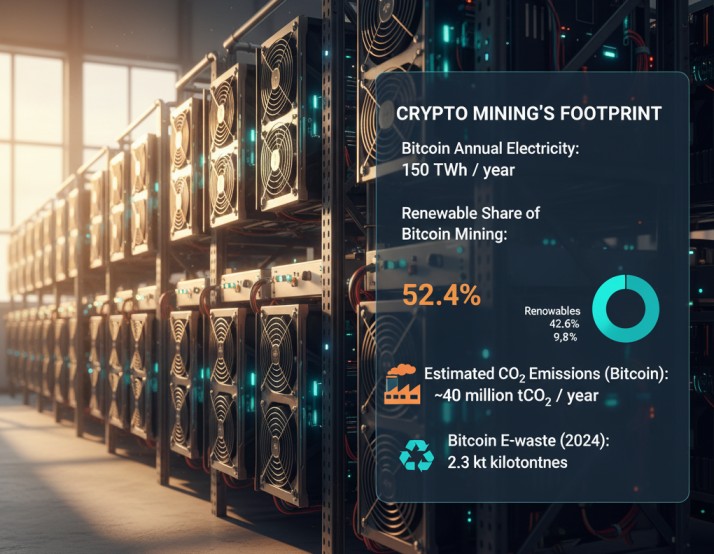
Cryptocurrency mining (often simply called crypto mining) is the process of verifying blockchain transactions and minting new coins using high-powered computers. “Miners” – who range from hobbyists running a few GPUs at home to industrial-scale data centers – compete in solving complex math puzzles. Each solution requires so much computing power that it “guzzles electricity” and often relies heavily on fossil fuels reuters.com. In practice, this means miners run thousands of specialized chips (ASICs, GPUs) around the clock. The result is an intensely energy-hungry process: for example, Digiconomist estimates Bitcoin now emits nearly 98 million tonnes of CO₂ per year, comparable to a nation like Greece carboncredits.com. Crypto mining also generates electronic waste: a Cambridge report estimates about 2.3 kilotonnes of e‑waste from Bitcoin rigs in 2024 jbs.cam.ac.uk, since mining hardware quickly becomes obsolete.
What Is Crypto Mining?
Crypto mining underpins the security of many blockchain networks. In proof-of-work (PoW) systems like Bitcoin, miners bundle pending transactions into a block and solve a cryptographic puzzle to “unlock” that block. The first miner to find the solution adds the block to the chain and earns newly minted coins plus transaction fees. This competition is what secures the network and prevents fraud. However, solving these puzzles is deliberately hard – requiring immense trial-and-error computation – so miners burn through vast electrical energy. According to Reuters, this process “guzzles electricity” and has a “heavy reliance on polluting fossil fuels such as coal” reuters.com. In other words, the very mechanism that makes Bitcoin and similar cryptocurrencies trustless also makes them power-hungry.
Notably, the people (and companies) doing crypto mining have changed over time. In Bitcoin’s early days, solo hobbyists mined on personal computers. Today, crypto mining is dominated by professional farms and pools. For example, a Cambridge study finds North America (primarily the U.S. and Canada) now accounts for over 82% of reported Bitcoin mining hashrate jbs.cam.ac.uk. Large public companies (like Marathon, Riot, and CleanSpark) and thousands of small operators all contribute. Even smartphones and home rigs can mine much less efficiently, so the market has consolidated into the hands of those with access to cheap, reliable power. Yet in every case, the term crypto mining refers to running dedicated hardware to validate transactions and secure a cryptocurrency. Whether people call it Bitcoin mining or Litecoin mining or simply crypto mining.
Energy Consumption and Environmental Impact
The scale of energy use by crypto mining is staggering. Estimates vary, but even the lower bounds are huge. For instance, Cambridge’s Bitcoin Electricity Consumption Index once pegged Bitcoin around 120 TWh/year; more recent analyses suggest closer to 175 TWh as of 2025. (TerraFlow Energy and Digiconomist both note figures in that range.) To put this in perspective, 120–175 TWh is roughly equal to the total annual electricity demand of countries like Argentina or Poland carboncredits.com. Crypto mining’s global electricity draw has been compared to mid-sized nations. One Reuters analysis noted that Bitcoin mining’s power use rivals the entire Netherlands’ 2019 consumption reuters.com.
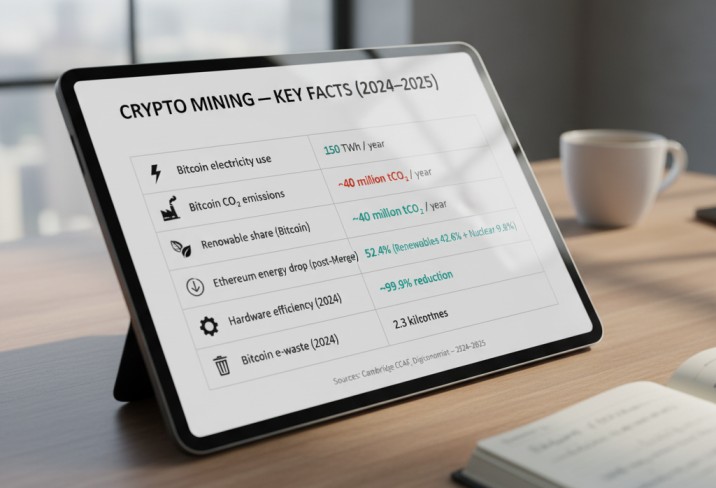
Such massive energy use produces a large carbon footprint. For example, one widely-cited estimate attributes about 672 kg of CO₂ per Bitcoin transaction carboncredits.com (roughly a 1,600 km car trip). Overall, Bitcoin mining alone now contributes on the order of 0.7% of global CO₂ emissions carboncredits.com. The Cambridge Centre for Alternative Finance (CCAF) reported network-wide emissions of ~39.8 million tonnes CO₂-equivalent for Bitcoin in 2024 jbs.cam.ac.uk.
Beyond carbon, crypto mining has other environmental effects. Large mining farms consume water for cooling and create noise and heat pollution. And as mentioned, e-waste is a factor: Miners often discard or resell ASIC machines after only a few years. The Cambridge report finds about 2.3 kilotonnes of Bitcoin e-waste in 2024 jbs.cam.ac.uk. Though it notes that most hardware (≈87%) is repurposed or recycled jbs.cam.ac.uk. Still, critics worry about the trend: if Bitcoin scales further, even a small percentage increase in energy intensity could thwart climate goals.
The question of who bears the cost – and who has the right to power-intensive crypto – is the heart of the debate.
The Debate: Critics vs. Supporters
Critics of crypto mining paint it as an energy “boondoggle” that undermines climate efforts. They argue that society could better use the electricity for homes, industry, or transportation. Environmental groups and some policymakers point out that much mining runs on coal or gas grids in regions like China (before its 2021 ban) or certain U.S. states, making it a source of pollution reuters.com. One IMF working paper warned that crypto mining alone could generate about 0.7% of the world’s CO₂ emissions by 2027 if trends continue imf.org. This bleak outlook has prompted actions: for example, China banned crypto mining, and some U.S. states have proposed limiting it on environmental grounds. In sum, the anti-mining camp sees it as a serious climate issue that requires restriction or carbon pricing (the IMF even suggested taxing mining electricity to curb it imf.org).
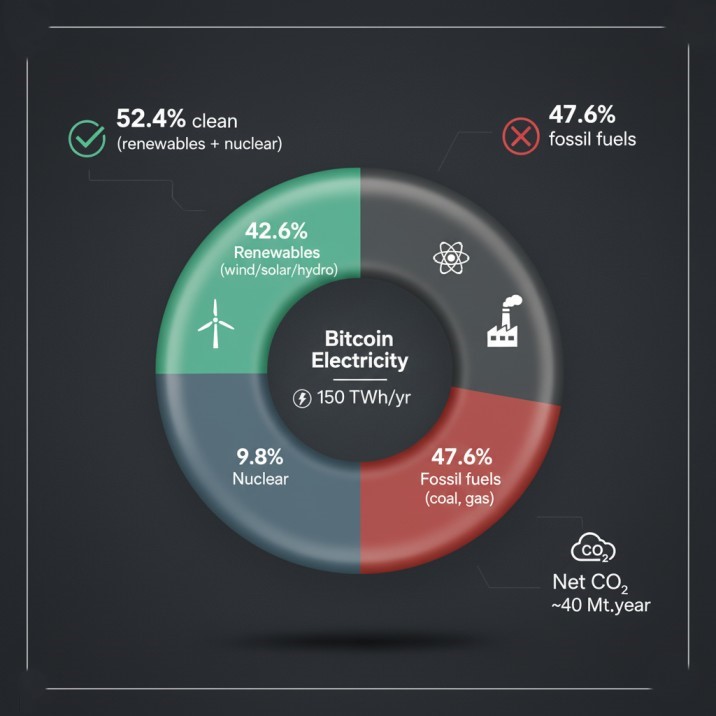
On the other hand, many in the crypto community contend that the benefits or context can outweigh the costs. Proponents highlight that much of Bitcoin mining already uses renewable energy. A 2025 Cambridge report found over 52% of Bitcoin’s electricity was from “sustainable” sources (renewable or nuclear) carboncredits.com, up from ~38% in 2022. They point out that mining can absorb stranded or excess power. For instance, miners in Texas famously shut down 1.5 GW of rigs within minutes during a winter storm in 2022. Freeing electricity to stabilize the grid blink.sv. Crypto projects also harness energy that would otherwise go to waste. Startups are capturing flared natural gas from oil fields and using it to mine Bitcoin, cutting those emissions by up to 63% versus burning off the gas blink.sv.
Economists note that the pure power draw of crypto is neutral in the energy market. If miners demand electricity, total generation still must meet it, but the source (coal vs. wind) depends on economics and policy. Supporters thus push for solutions like siting mines near renewable plants or enacting carbon prices. The debate remains open-ended: as of now, crypto mining undeniably consumes a lot of energy. The trend toward renewables and efficiency has steadily improved its profile.
Innovations and Green Solutions for Crypto Mining
Faced with these pressures, the crypto industry and regulators are exploring ways to cut mining’s footprint. Practical solutions include:
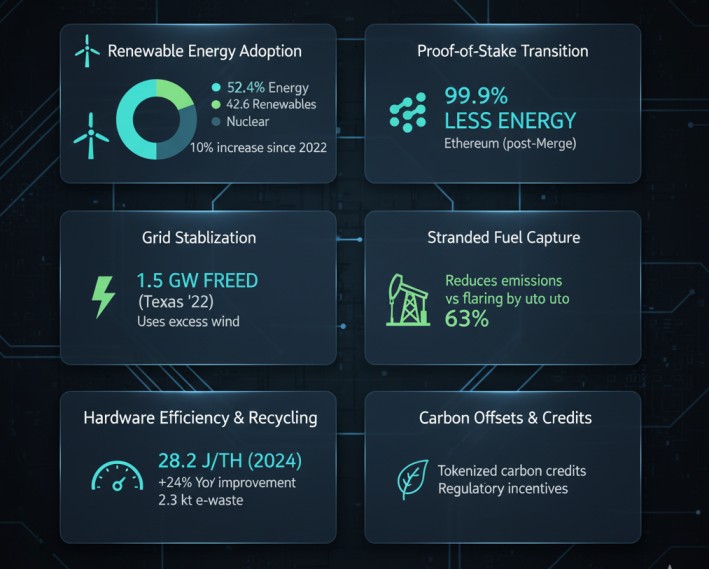
- Renewable Energy Adoption: Many mining firms are relocating to regions with abundant green power or directly using renewable sources. A recent Cambridge study reports that 52.4% of Bitcoin mining electricity comes from clean sources (42.6% renewables like hydro/wind/solar, plus 9.8% nuclear) carboncredits.com. Major companies now operate in Iceland, Norway, and Texas wind states, often matching their usage with solar or hydro contracts. This trend is increasing – the share of renewable-powered mining has jumped over 10 percentage points since 2022 carboncredits.com.
- Proof-of-Stake Transitions: Changing the consensus algorithm can slash energy needs by orders of magnitude. Ethereum’s 2022 “Merge” to Proof-of-Stake is a striking example: it reduced Ethereum’s electricity consumption by ~99.9% iberdrola.com (from country-scale to town-scale levels). Their creators built newer blockchains like Cardano, Polkadot, Tezos, Algorand, and many others as Proof-of-Stake (PoS) from day one. Their operation avoids the energy-burn of PoW mining altogether. (By design, PoS networks select validators based on stake rather than computation, which “significantly reduces the need for energy-intensive computations” iberdrola.com.) The proof-of-work model itself is being questioned. Even Bitcoin has seen proposals for lower-power forks or rewards for using green power.
- Grid Stabilization and Energy Storage: Miners can act as a flexible electrical load. For example, Bitcoin rigs can be throttled up or down on demand. In practice, operations have signed agreements with grid operators. During peak demand or disruptions, miners shut off their machines to free up power for homes. The Texas winter 2022 case (1.5 GW instantly freed blink.sv) is one clear instance. Additionally, mining can be combined with battery storage or used to monetize excess energy. Renewable plants often spill energy when production exceeds demand – miners can soak up that excess. A study found that in 2022, Bitcoin mining consumed about 1.3 TWh of wind energy that would otherwise have been curtailed in West Texas, improving grid efficiency (and generating revenue for wind farms) blink.sv.
- Stranded Fuel Capture: Some projects convert waste fuel into mining power. Companies like Crusoe Energy and Upstream Data capture flared natural gas (a byproduct of oil drilling) and use it to run Bitcoin miners. This turns a normally wasted resource into electricity, cutting CO₂ emissions dramatically. For example, Crusoe’s gas-to-power sites have mitigated millions of cubic feet of flared gas per day, roughly equivalent to removing over 120,000 cars from the road blink.sv. By monetizing stranded energy, crypto miners can even help oil and gas fields reduce their carbon footprint.
- Hardware Efficiency and Recycling: Mining hardware is getting more efficient. A 2024 survey found miners achieved a 24% year-over-year improvement in energy efficiency (now around 28.2 joules per terahash) jbs.cam.ac.uk. New ASIC models do far more work per watt than older ones. Miners also often resell or repurpose old hardware. In fact, a majority of retired Bitcoin machines (≈87%) are recycled or reused jbs.cam.ac.uk. This reuse keeps e-waste relatively low – only a few kilotonnes per year by some estimates.
- Carbon Offsets and Credits: Some firms buy carbon offsets or fund green projects to neutralize emissions, though critics note that offsets are not a complete solution. Nonetheless, initiatives like tokenized carbon credits are emerging. Also, regulators are looking at taxing carbon or electricity to push mining toward cleaner power, which could accelerate change.
Together, these measures illustrate how the industry is adapting. To be sure, no single solution makes crypto carbon-free overnight. But a combination of cleaner power, smarter protocols, and regulatory incentives can significantly reduce the environmental toll of mining.
Green Cryptocurrencies and Eco-Friendly Projects
Not all cryptocurrencies are equal in energy impact. In fact, an entirely new class of green coins has emerged, designed to be sustainable from the ground up. These projects typically use low-power consensus or innovative resource models:
- Proof-of-Stake Platforms: As mentioned, Cardano (ADA) is one of the earliest “green” coins. Its Ouroboros protocol (a PoS system) is peer-reviewed and explicitly designed to keep energy use minimal iberdrola.com. Algorand and Tezos similarly use PoS, with Algorand even aiming to be carbon-neutral through offsets.
- Consensus Innovations: Solana uses a hybrid “Proof of History” that enables very fast, low-energy transactions. Solana claims an average transaction consumes roughly the energy of a single Google search iberdrola.com. Stellar uses an “efficient Byzantine” consensus that avoids any mining-like computations iberdrola.com.
- Proof-of-Space/Time Models: Chia (XCH) is notable for introducing Proof of Space and Time, where miners commit hard-drive storage rather than raw CPU/GPU power. This shifts the resource from energy to disk space, greatly reducing electricity draw iberdrola.com.
- Other Sustainable Projects: Newer chains continue to emphasize green credentials. For instance, Nano and Holochain use directed acyclic graph (DAG) models with negligible power, and projects like Avalanche and Polygon offer carbon credit integrations. Even Bitcoin has seen “clean Bitcoin” initiatives where coins are tagged based on greener mining sources.
These green cryptocurrencies and initiatives show that developers can build blockchain in an eco-friendly way. They often come with trade-offs (like different trust models), but they prove that “mining” doesn’t have to mean excessive energy use.
Conclusion
Crypto mining’s energy appetite has sparked a heated environmental debate. On one hand, the sector has a real carbon footprint and is scrutinized by governments and climate advocates. On the other hand, the industry is innovating quickly. Renewable-powered mining, proof-of-stake systems, and novel energy projects are steadily reducing the ecological impact. The journey isn’t over: Bitcoin and other PoW coins still consume vast power, but the growth of alternatives and efficiency gains offers hope.
The story of crypto mining will be written in the coming years. Policymakers, investors, and engineers are all weighing in: should crypto face tougher regulation, or can market forces drive it to become clean? As one Cambridge researcher put it, “We are trying to show what Bitcoin’s footprint is” to guide evidence-based decisions reuters.com. Whether you view crypto mining as an environmental villain or a driver of renewable innovation, its future depends on continued transparency and technological progress.
What do you think? Share your thoughts below. Stay tuned for more deep dives into cryptocurrency and sustainability. Also subscribe for updates on how the tech world tackles its climate impact.