

Imagine waking up tomorrow and finding your crypto locked behind an exchange you can’t access—sounds scary, right? In fact, that’s exactly why choosing among the best centralized exchanges is not just about flashy features or marketing hype. It’s about trust, safety, and daily usability.
In this blog, we’re going to peel back the layers of centralized exchanges (CEXs), present a well-researched list of the Top 5 best centralized exchanges, and then walk you through how to evaluate them—by fees, security, and user experience. Along the way, I’ll share some observations and cautionary lessons I’ve picked from real-world users and the evolving crypto landscape.
Let’s dive in.
Why Centralized Exchanges (CEXs) Still Dominate
Before we jump into the rankings, it’s worth asking: why do many people still rely on CEXs in a world aspiring to decentralization? The answer is a mix of convenience, liquidity, fiat on/off ramps, and regulatory compliance.
Advantages of CEXs
Liquidity & Depth: Big centralized exchanges (CEXs) gather far more users than most decentralized exchanges (DEXs), which translates into tighter spreads and faster execution.
Fiat Bridges: It’s easier to deposit and withdraw fiat (USD, EUR, local currency) through CEXs, making them gateway platforms for mass adoption.
User Support & Tools: KYC, customer service, margin trading, staking, derivatives — these features are more mature in the centralized world.
Onboarding for Beginners: Many new users feel more comfortable with a download-and-go app rather than messing with wallet keys and smart contracts.
Risks & Trade-offs
- Custodial Risk: When you deposit funds, you trust the exchange to safeguard them. Hacks or insider mismanagement can lead to losses.
- Regulation & Shutdown: Governments may restrict or close exchanges, or force KYC/AML rules that reduce privacy.
- Centralized Failure Points: A single point of failure (technical or legal) can compromise many users at once. The Bybit hack (≈ $1.4B stolen) is a recent high-profile example. Wikipedia
- Market Concentration: Exchanges like Binance dominate trading volume, creating systemic risks if they fail. Reuters
Given these advantages and caveats, the role of a CEX becomes not just a trading venue, but a kind of hybrid — part bank, part tech company, part marketplace.
Top 5 Centralized Exchanges in 2025
Below are my picks for Top 5 CEXs in 2025, along with what makes them stand out. (Note: “best” is context-dependent — your priorities might differ.)
Criteria for Selection
When choosing, I weighted:
- Security & trust record (past incidents, transparency)
- Fee structure & hidden costs
- User experience (UX), onboarding, mobile/web apps, API
- Liquidity, volume, and supported assets
- Regulatory compliance & geography
Here are my picks (in no particular order of absolute rank):
1. Binance: The Global Volume Leader
Why it makes the list:
Binance is arguably the most versatile and powerful CEX. It leads in trading volume (per CoinMarketCap rankings). CoinMarketCap
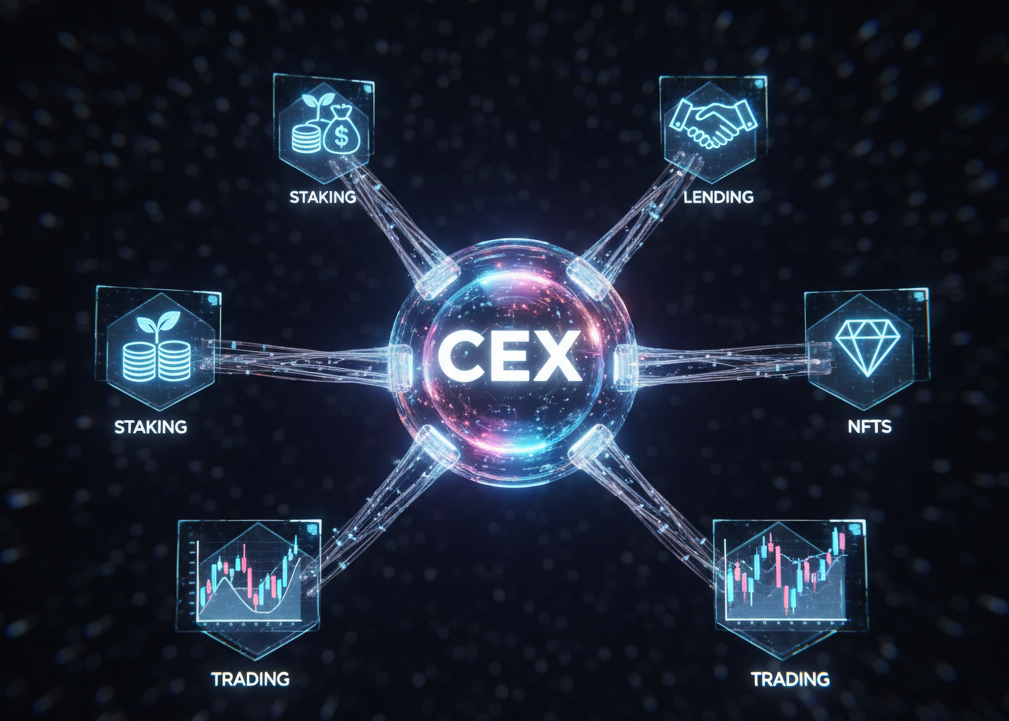
Its ecosystem spans spot, futures, staking, earning, NFTs, loans, and its native token (BNB) gives discounts.
Strengths
- Extremely low base fees (e.g. ~0.10% maker/taker) and deeper discounts for high-volume traders or BNB use. nadcab.com
- Massive liquidity and broad support across many tokens.
- A mature suite of products — margin, futures, staking, etc.
Cautions
- Regulatory scrutiny: Binance faces legal/regulatory pressures in multiple jurisdictions.
- Complexity: With so many features, new users may find it overwhelming.
- Centralization risk: Because of its scale, any outage or regulatory ban would have ripple effects.
2. Kraken: The Security-First Powerhouse
Why it makes the list:
Kraken has long flown under the radar compared to flashy exchanges, but it shines in trust and security. Kraken
It is one of the few major exchanges that has never lost customer funds owing to a hack. Kraken
Strengths
- Strong security posture, conservative practices, and trust among long-term users.
- Reasonable fees with “maker/taker” model. Wikipedia
- Good balance between usability and advanced features (e.g. Kraken Pro).
Limitations
- Deposit/withdrawal latency can be slower in some cases.
- Fewer exotic tokens compared to Binance.
- UX is less polished than some newer, app-first platforms.
3. Coinbase: The Beginner-Friendly Beacon
Why it makes the list:
Coinbase is often the first stop for U.S. retail users. Ultimately, it’s well-known, regulated in the U.S., and relatively safe for beginners. Kraken
Strengths
- Excellent UX, onboarding, and reputation.
- Strict regulatory compliance and transparent operations.
- Integration with institutional and wallet services, plus its acquisition of Deribit adds derivatives depth. Wikipedia
Trade-offs
- Higher fees than many alternatives (especially for smaller trades). Forbes
- Fewer advanced features in its basic interface.
- Occasional outages or high latency under load.
4. Crypto.com: The Mobile-First Powerhouse
Why it makes the list:
Crypto.com is making a name for itself as a well-rounded exchange + app combo. Finder names it its top pick for “best overall” for its balance of cost, security, and usability. finder.com
Strengths
- Very low maker and taker fees in many use cases. Forbes
- Rich feature set: staking, credit card integration, lending, and rewards.
- Attractive UX, mobile-first design, and promotional offerings.
Trade-offs
- Some features and perks are conditional (e.g., token holdings).
- In some jurisdictions, regulatory risk or restrictions can arise.
- Less long-term track record compared to giants like Coinbase or Binance.
5. Gemini: The Regulated Gateway
Why it makes the list:
Gemini trades more conservatively but emphasizes security, regulation, and ease of use. It’s often recommended for users who prioritize trust over lowest-cost trades. Forbes
Strengths
- Strong compliance and regulatory posture (especially in the U.S.).
- Clean, intuitive interface with educational features for new users.
- Insurance coverage, robust custody solutions.
Trade-offs
- Fees are higher compared to Binance or some alternatives.
- Smaller token selection and lower liquidity on less-traded assets.
- Not as many “extra” features (lending, derivatives) as others.
Top 5 Centralized Exchanges (CEXs) — Fee, Security & UX Snapshot
| Exchange | Approx Maker / Taker Fee* | Notable Security Strengths | UX & Tools Highlights | Notes / Caveats |
|---|---|---|---|---|
| Binance | ~ 0.10% / 0.10% (lower with BNB) | Large team, audits, risk controls | Wide feature breadth, powerful APIs | Regulatory exposure in many jurisdictions |
| Kraken | ~ 0.16% / 0.26% (varies) | Never lost customer funds, conservative operations | Clean interface + advanced Pro version | Less flair for token hunting |
| Coinbase | ~ 0.40% / 0.60% (or more) | Transparent operations, regulated U.S. presence | Beginner-friendly, mobile-first | Higher costs, occasional outages |
| Crypto.com | Low in many tiers (e.g., 0.075%) | Insured reserves, multiple security layers | App-centric, full feature suite | Some perks require token staking |
| Gemini | ~ 0.20% / 0.40% | High compliance, strong custody, insurance | Clean, educational onboarding | Fewer bells and whistles |
*Fees shown are indicative, may vary by region, volume tier, and payment method. Always check the official site.
Evaluating Exchanges by Core Dimensions
To find your ideal “best crypto exchange,” let’s break down the critical evaluation axes.
Fees & Hidden Costs
It’s tempting to pick the platform with the lowest headline fee, but real costs often hide beneath:
- Maker vs. Taker: Many exchanges differentiate — providing rebates or lower fees for liquidity (makers).
- Spread / Slippage: Low trading volume or thin markets increase the effective cost.
- Deposit & Withdrawal Fees: Sometimes fiat withdrawals or blockchain gas costs erode gains.
- Conversion Costs & Markups: Some platforms embed hidden markups in fiat ↔ crypto conversions.
- Tiered Pricing & Discounts: Volume-based discounts, token holding (e.g. BNB on Binance), or loyalty levels can reduce fees.
Tip from experience: I once executed a “cheap” trade on a flashy exchange, only to discover the withdrawal cost ate 30% of my gain. Always simulate end-to-end (trade + withdrawal) before committing.
Security & Trust
Security is non-negotiable. Some key markers:
- Cold / Offline Storage: Exchanges that store most funds offline reduce hack risk.
- Proof of Reserves / Audits: Transparent reporting or third-party audits help validate solvency.
- Insurance Reserves / Backstops: Some exchanges carry insurance or maintain reserve funds to cover losses.
- History of Breaches: Past hacks shouldn’t be automatic disqualifiers, but how a platform responded matters (e.g. customer reimbursements).
- Operational Transparency & Governance: How well is the exchange run? Are there known insiders or opaque ownership?
As an example, Kraken’s reputation for never losing customer funds lends confidence. Kraken Conversely, the Bybit hack in 2025 (≈ $1.4B) is a stark reminder: even big names can suffer. MarketWatch
User Experience (UX) & Tools
A great exchange fails if it’s unbearable to use. UX includes:
- Onboarding friction: KYC delays or frequent rejections can frustrate.
- Mobile / Web interface quality: Responsiveness, clarity, customization matter.
- Order types & charting tools: Advanced traders want stop-limit, OCO, etc.
- APIs & integration: For algorithmic trading or apps, solid APIs are key.
- Customer support & education: Prompt responses and learning material help, especially for newcomers.
I’ve seen novice users abandon a “low-fee” exchange simply because the interface confused them.
The Wider Role of Centralized Exchanges in the Crypto Ecosystem
It’s easy to view CEXs as just trading venues. Their influence, however, is far broader.
Gateways to Fiat & Onboarding
For most people, buying crypto still often starts with depositing fiat (bank transfer, credit card). CEXs smooth that path, handling KYC, regulatory compliance, and fiat rails in ways that DEXs typically can’t.
Liquidity Hubs & Market Formation
Because many traders cluster in a few CEXs, they become reference points for prices and liquidity. Market makers, institutions, retail flows — they converge there.
Innovation Bridging (Centralized Exchanges + DeFi Hybrids)
We’re seeing the lines blur: centralized exchanges adopting decentralized primitives (e.g., internal AMMs, liquidity pools, non-custodial features). Some are launching on-chain derivatives or cross-chain bridges.
Institutional Access & Trust Anchor
Big financial firms often prefer regulated, audited, custodial platforms instead of DeFi’s wild west. CEXs are the on-ramps for institutions entering crypto.
Regulatory & Systemic Impact
Because so much volume is concentrated in major exchanges, their behavior and risk profile impact the whole crypto ecosystem. Regulatory moves (e.g., bans, forced disclosures) can cascade. The EU’s concern over concentration in exchanges—especially Binance handling half the market’s volume—is one such signal. Reuters
Personal Observations & Anecdotes
- A friend once lost faith in a small CEX because their withdrawal suddenly required “extra verification.” She moved everything to Kraken and felt safer.
- In one bull run flash crash, some exchanges (less mature ones) suspended withdrawals — the panic was worse than the price drop.
- Token listing matters. I’ve allocated capital to smaller altcoins only listed on exchanges I trust—even though “cheaper listings” were available elsewhere.
These stories underscore a lesson: the “best centralized exchanges” is not always the cheapest or flashiest — often it’s the one you can reliably use, trust, and recover from problems.
Final Thoughts & Recommendations
So, which centralized exchange CEX is the best? There’s no one-size-fits-all answer. But here’s a quick guide based on your priorities:
- Max liquidity & feature set → Binance
- Security & long-term trust → Kraken
- Regulated U.S. presence & onboarding ease → Coinbase
- Rewards + modern app experience → Crypto.com
- Compliance-first comfort for cautious users → Gemini
Whatever you choose, always diversify risk — don’t keep all your assets on one exchange, and regularly withdraw what you’re not actively trading. Use hardware wallets when possible, and keep two-factor authentication, withdrawal whitelist, and alerts enabled.
I’d love to hear your experiences:
- Which centralized exchange do you trust most, and why?
- Have you faced withdrawal issues or surprises?
Share your story in the comments below. If you found this useful, feel free to share or subscribe for deeper content on trading strategies, DeFi, and crypto infrastructure. Let’s build a safer, more informed crypto community together.



Pingback: DEX vs CEX: Decentralized vs Centralized Crypto Exchanges 2025 - tokensbuzz.com
Pingback: Cryptocurrency Investment Strategy Beginner’s Guide - Start Smart - tokensbuzz.com
Pingback: What Are Meme Coins? DOGE, SHIB & PEPE Explained 2025 - tokensbuzz.com
Pingback: Crypto Day Trading vs. Swing Trading: A complete Guide - tokensbuzz.com
Pingback: FTX Collapse: Key Lessons, Failures & $1.6B Recovery Update - tokensbuzz.com
Pingback: Best Coins to Stake in 2026 | Top Crypto Staking Coins - tokensbuzz.com
Pingback: How to Buy Bitcoin: Step-by-Step Guide for Beginners - tokensbuzz.com