


For crypto investors and enthusiasts, crypto hacks have been an alarming headache in 2025. Attackers siphoned off over $3.4 billion in stolen funds from blockchain platforms – slightly more than the previous year’s total. Remarkably, a handful of massive breaches drove most of the losses. For example, the February 2025 hack of the Bybit exchange alone netted about $1.5 billion, nearly half of all thefts. This year’s figures show how a few mega-incidents on major crypto sites can skew the entire year’s crime statistics mexicobusiness.news. Understanding these events is crucial for anyone in crypto today.
Crypto Hacks in 2025: Record Theft Figures
Blockchain intelligence firms report that hackers stole more than $3.4 billion in cryptocurrency during 2025. This total is only slightly higher than 2024’s losses, indicating theft remains at historically high levels bankinfosecurity.com. Crucially, the losses were extremely concentrated: Chainalysis notes that the top three hacks of 2025 accounted for 69% of all service-related losses coinglass.com. In plain terms, a very small number of breaches (like the Bybit incident) dominated the overall tally.
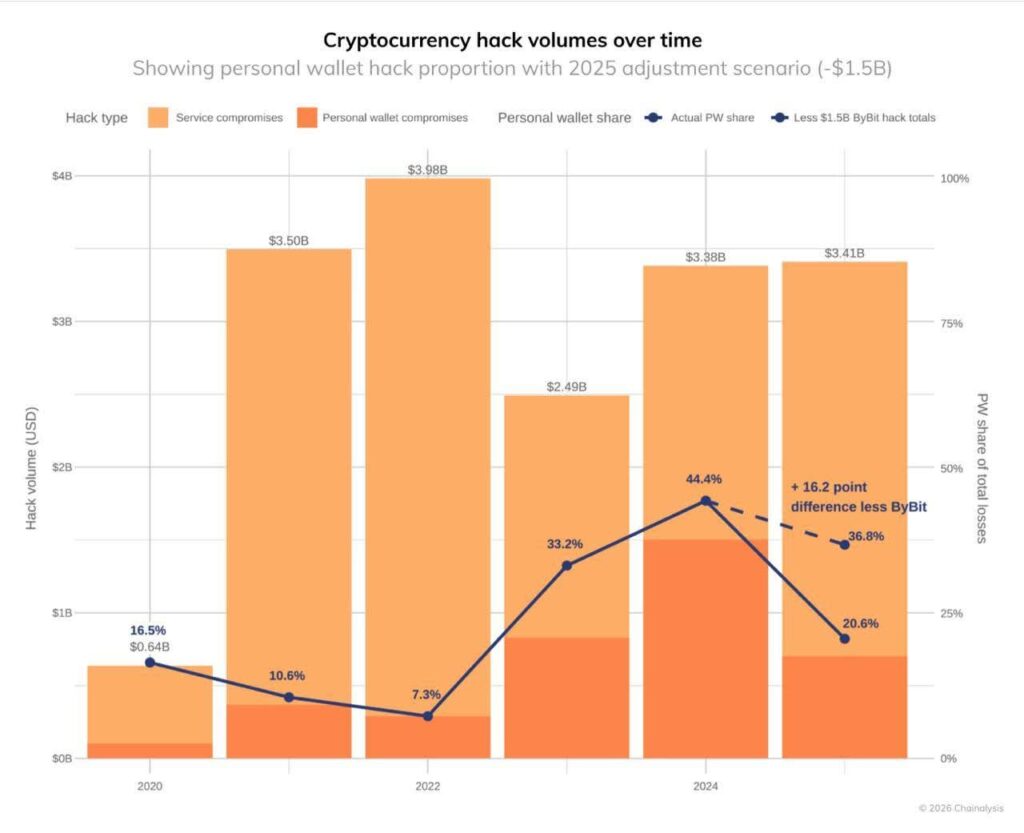
A summary of yearly losses and major hacks:
| Year | Total Stolen (Hacks) | Notable Hacks (Loss) |
|---|---|---|
| 2024 | ~$2.2B | DMM Bitcoin (May ’24, $305M); WazirX (Jul ’24, $235M) chainalysis.com |
| 2025 | $3.4B+ | Bybit (Feb ’25, $1.5B); Upbit (Nov ’25, ~$30M) reuters.com |
The table shows that 2025’s thefts exceeded prior years. Notably, a single event – the Bybit breach – contributed almost half of 2025’s losses. Other major platforms were hit too. For instance, South Korea’s largest exchange Upbit lost about $30 million in an unauthorized withdrawal late in 2025 reuters.com (suspected to involve the same DPRK-linked group). These high-profile incidents on top crypto sites drove the headline numbers for 2025.
Major Crypto Hack Incidents of 2025
2025 saw several shocking hacks on big exchanges and protocols:
- Bybit Exchange (February 2025): North Korean hackers (Lazarus Group) broke into Bybit via a third-party vulnerability and stole ~$1.5B in crypto. This single breach accounted for ~44% of the year’s total theft mexicobusiness.news. Supply-chain flaws like this one – targeting the infrastructure behind exchanges – are now a prime concern.
- Upbit Exchange (November 2025): An “abnormal withdrawal” at Upbit led to about 44.5 billion won (~$30.4M) vanishing reuters.com. South Korean authorities quickly linked the style of this hack to DPRK’s Lazarus Group (the same nation-state crew behind Bybit). While smaller in value, the Upbit incident showed that even top exchanges with strong defenses can be breached.
- Other Incidents: Beyond exchanges, new trends appeared. DeFi attacks were fewer: a September 2025 compromise of Venus Protocol was quickly detected and stopped (community monitors halted $3M of the theft) coinglass.com. On the user side, 2025 saw many wallet-level attacks (phishing, credential theft) affecting individuals globally.
Together, these events illustrate a shift: attackers are focusing on well-protected platforms and supply-chain weaknesses, rather than easy smart-contract exploits. (See Comparison table above for a snapshot of big 2024–25 incidents.)
Key Trends in Crypto Hacks
Data from security researchers highlight several important trends in 2025:
- Nation-State Dominance: North Korea continued to dominate crypto theft. Chainalysis reports DPRK-linked hackers stole $2.02B in 2025 – a 51% jump over 2024. This is a record haul, making up roughly 76% of all large exchange hacks that year chainalysis.com. In short, state-sponsored groups (not ordinary cybercriminals) were behind most of the biggest losses. (Experts warn that much of this funding goes to North Korea’s weapons programs.)
- Few Breaches, Big Losses: 2025’s stolen total was driven by a few mega-breaches. The top three hacks (including Bybit) made up about 69% of service losses. This concentration means even one or two massive security failures can set records. As one analyst put it, removing the Bybit hack from 2025 would cut the total dramatically – but the underlying threat remains bankinfosecurity.com.
- Rise of Personal Wallet Attacks: More small victims were hit, even as total individual losses fell. Chainalysis found 158,000 personal wallet breaches in 2025, affecting ~80,000 people. Paradoxically, while more wallets were hacked, the average theft size dropped: total stolen from individuals fell from $1.5B in 2024 to $713M in 2025 coinglass.com. This suggests attackers are hitting many users for smaller sums (often via phishing or stolen keys) rather than seizing one victim’s life savings. Networks like Ethereum and Tron saw especially high victim counts per user base.
- DeFi Security Improves: Interestingly, DeFi protocol losses were surprisingly low even as Total Value Locked grew. In prior years, rising TVL usually meant more hacks, but 2025 broke that pattern. Quick detection and governance actions helped. For example, when Venus Protocol saw suspicious activity in Sept ’25, its team paused operations within 18 hours and recovered funds. These proactive measures (alerts, freezes, community votes) likely saved hundreds of millions. Overall, experts note that enhanced security practices and monitoring are making decentralized finance more resilient chainalysis.com.
- Continued Defi vs. CeFi Shift: As centralized services remain prime targets, security of private keys is paramount. Many 2024–25 hacks involved key compromises. In contrast, decentralized bridges and smart-contract exploits were less common in 2025. This marks a strategic shift: attackers now often exploit human and infrastructure weaknesses (phishing, corrupted insiders, API holes) rather than code bugs.
A Global Wake-Up Call
These findings show that crypto hacks are now a global, systemic threat. Losses totaling billions of dollars make it clear that no region or platform is immune. Investors and exchanges worldwide must take note. The year 2025 illustrates both the risk (massive, concentrated hacks) and some progress (improved DeFi safeguards) in crypto security.
What Can You Do? Stay vigilant. Use strong, hardware-backed wallets and never reuse keys. Exchanges and DeFi projects should invest in multi-layer security (penetration testing, monitoring, incident response). Governments and police are also more alert: e.g., the FBI and SEC have announced rewards and sanctions aimed at crypto theft networks.
Finally, ask questions: Are you comfortable with the security practices of your crypto platforms? How would a big breach affect you? Sharing insights and lessons from 2025 can help build a safer crypto future.
If you found these insights useful, share your thoughts below or with your network. Dive into our related posts on crypto security and hacking trends. Subscribe for regular updates – staying informed is your best defense against crypto crime.