


Imagine an internet where you control your data and digital assets – not giant tech platforms. That’s the promise of Web3 technology. This emerging generation of the web shifts power from centralized gatekeepers back to users, via blockchain technology. In practice, it means self-sovereign identity, digital “token” ownership, and peer-to-peer apps that run on code, not company servers. In this post we unpack what Web3 is, how it differs from today’s Web 2.0, and explore its future trends and unique use cases beyond finance. We’ll also show why Web3 adoption matters for businesses of all kinds, and how companies can start experimenting with it. Ready to dive in? Let’s go.
Defining Web3 technology
At its core, Web3 (often called Web 3.0) is envisioned as the “read-write-own” internet deloitte.com. Unlike Web 2.0 – where platforms like Facebook or Google “read-write” your content but ultimately own it – Web3 gives control back to users. You’ll hear it described as a shift from centralized platforms to decentralized networks. Harvard Business Review even calls Web3 “the future of the internet,” built on blockchain, cryptocurrencies, NFTs and DAOs, offering a web where “users have a financial stake in, and more control over, the web communities they belong to” deloitte.com. In other words, Web3 is the internet as a true owner-empowered ecosystem.
Web3 isn’t just one technology or a simple upgrade. As PwC explains, “Web3 is more than a singular technology… It’s an ethos that has the potential to empower consumers while strengthening the relationship [they] have with brands” pwc.com. It combines distributed ledgers (blockchains), smart contracts, and token systems into a new model of ownership. Web3 apps are often decentralized “dApps” where code runs on a network of computers, not a single company. The upshot? No single authority controls the service or your data. Users can own, trade, and transport digital assets freely.
Web3 vs. Today’s Web: In Web 2.0, platforms centrally store and monetize user data. Web3 replaces that with peer-to-peer networks. For example, you might log in with a crypto wallet instead of a Facebook account, and you keep ownership of your information.
key Differences Between Web 2.0 & Web3
| Feature | Web 2.0 (Today) | Web3 (Emerging) |
|---|---|---|
| Data Ownership | Data and identity are owned by platforms (e.g. social networks) pwc.com | Users control their data via blockchain wallets; identity is portable pwc.com |
| Privacy | Limited; user data is often collected & sold for ads | Enhanced; users consent to data sharing and can revoke it (self-sovereign identity) |
| Interactions | Centralized through intermediaries (banks, apps) | Decentralized and peer-to-peer (trusted by code) mckinsey.com |
| Monetization | Platforms profit from ads/subscriptions (you create value for them) | Users and creators earn directly via tokens/NFTs pwc.com |
| Governance | Rules set by companies or governments | Community-driven (e.g. DAOs) and transparent via smart contracts |
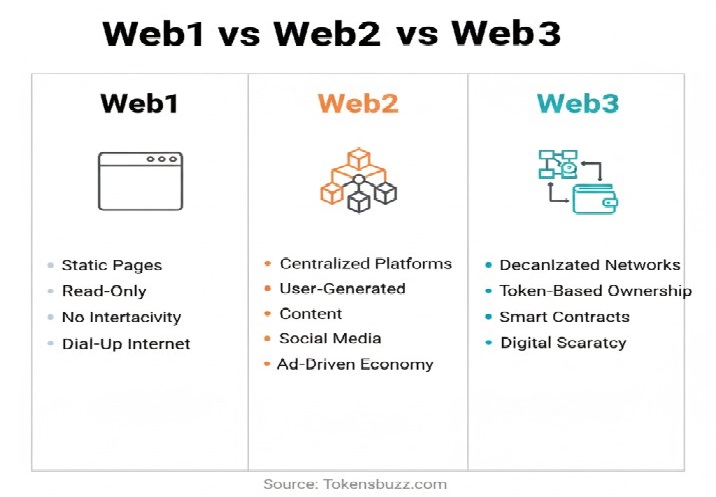
The shift to Web3 technology comes with three core building blocks. First, blockchain – a distributed ledger where anyone can read/write data – replaces proprietary databases mckinsey.com. Second, smart contracts – code that automatically executes on the blockchain – replace intermediaries and manually enforced agreements mckinsey.com. Third, digital tokens and assets (including cryptocurrencies and NFTs) represent ownership and fuel new economies mckinsey.com. Together, these enable a web where trust comes from open code and math, not middlemen.
Key Pillars of Web3 Technology
Let’s break down how Web3 technology works under the hood:
- Blockchain (Distributed Ledger): Data is stored in blocks that are chained together across a network of computers. Anyone can verify the entire history of transactions, making the system tamper-resistant mckinsey.com. There’s no single database or server to attack, so there’s no single point of failure or censorship mckinsey.com.
- Smart Contracts: These are self-executing pieces of code on the blockchain. When predefined conditions are met, they automatically carry out actions (like transferring tokens) mckinsey.com. This allows transactions (financial, legal, or otherwise) to happen without human intermediaries. For example, a smart contract might instantly release payment when a shipment’s GPS confirms delivery – no bank or notary needed.
- Digital Tokens & Assets: Anything of value – money, art, property deeds, loyalty points – can be represented as a token on the blockchain. Cryptocurrencies (like Bitcoin or Ether) are one type (often incentivizing network security). Stablecoins track real currencies, and NFTs (non-fungible tokens) represent unique assets (art, collectibles, real estate deeds). These tokens live on-chain and can be sent, traded, or even programmed to pay royalties. In short, tokens bring ownership and economy to digital things mckinsey.com.
Together, these pillars enable trustless applications. For example, you could vote in a DAO (decentralized autonomous organization) with a token that proves your stake, without needing an election official. Or you could stake tokens to run a node in a blockchain network, earning rewards. The possibilities are expanding as Nokia’s research highlights, modern Web3 apps are exploring decentralized social media, video streaming, music platforms, and more on blockchain networks nokia.com. In just a few years, Ethereum grew to over 5,000 Web3 developers (up 400% since 2018) nokia.com, showing growing industry interest.
The Future of Web3 Technology
How big could Web3 become? Industry forecasts are eye-opening. For example, Grand View Research projects the global blockchain market (the backbone of Web3) will surge from ~$31 billion in 2024 to $1.43 trillion by 2030 (a 90% CAGR!) grandviewresearch.com. This stacks up as one of the fastest-growing tech sectors on record.
According to the research one thing is clear: enterprises and investors are already betting big on Web3-related tech. A CasperLabs survey of 603 global companies found that 87% of businesses planned to invest in blockchain in 2023, and almost 90% had already begun using it in some form proveai.com. In other words, nearly all large companies see value in this technology. According to Deloitte, 315 major brands launched a total of 526 Web3 projects during 2022 and early 2023 deloitte.com. These ranged from experimental NFT drops to blockchain loyalty cards.
As the hype settles, a core message emerges: Web3 is still in its infancy, but it’s mainstream enough that no company can afford to ignore in pwc.com. PwC bluntly advises business leaders: “begin to formulate a Web3 strategy and… experiment with the framework.” pwc.com. In practice, that means companies should at least learn about token-based business models, try small pilot projects, and monitor regulatory changes. After all, just as the mobile internet transformed business over a decade, Web3 could reshape industries in the 2020s.
Despite these bullish signals, some caution remains warranted. As McKinsey notes, Web3’s road is “bumpy” – issues like scalability (handling millions of users), fraud, and fragmented regulations still slow progress mckinsey.com. User-friendliness is also a challenge: the current generation of wallets and dApps often intimidates non-technical users. However, progress is rapid: new layer-2 solutions promise faster transactions, and tech giants now offer “blockchain-as-a-service” tools. Over time, these hurdles may ease, paving the way for broader Web3 adoption.
Web3 Technology Use Cases Beyond Finance
When many people hear “Web3,” they think of cryptocurrency or NFTs. But Web3’s potential extends far beyond finance. Here are some emerging non-financial use cases:
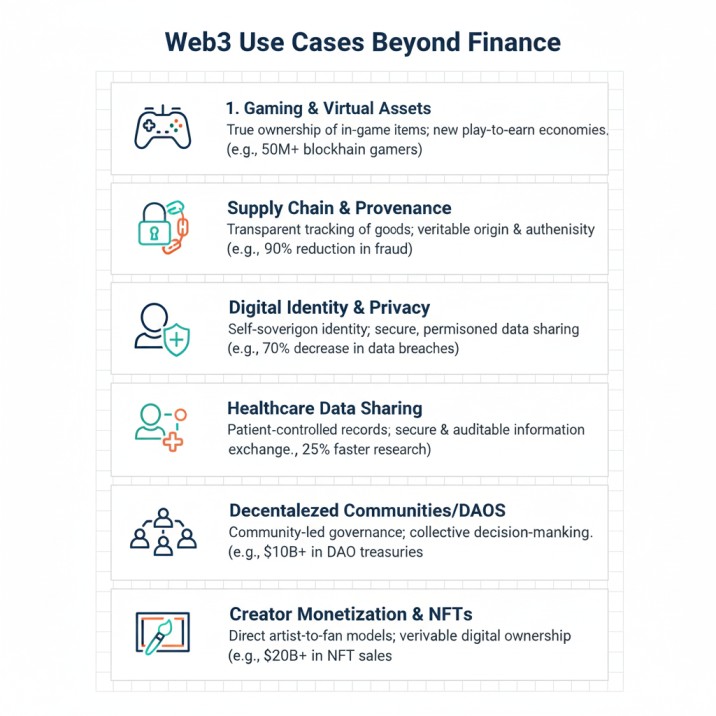
- Gaming and Virtual Worlds: Web3 games reward players with cryptocurrency and NFTs that represent real ownership of in-game items. For example, Axie Infinity lets gamers earn tokens that they can trade or sell – the gamers truly own their assets on-chain adjust.com. This contrasts with Web2 games, where digital items can vanish if a company shuts down. Web3 gaming is still experimental, but it promises interoperability: items from one game might be used in another, all thanks to blockchain standards.
- Content and Creativity: Web3 unlocks new monetization for artists, musicians and creators. By minting art or music as NFTs on platforms like OpenSea or Sound.xyz, creators earn royalties automatically from each resell adjust.com. Fans become direct patrons. This reduces dependence on platforms (like YouTube or Spotify) that take big cuts. In effect, the internet becomes a marketplace where creators set the rules and share in the value of their work.
- Decentralized Communities (DAOs): Organizations can form around smart contracts with token-based voting. Unlike traditional firms, a DAO has no single boss – stakeholders vote on budgets and plans directly. Real-world examples include MakerDAO, which governs a crypto lending system, and Decentraland, a decentralized virtual world run by its users. Such models could apply to co-ops, investment clubs, or even self-organizing companies of the future.
- Supply Chain & Provenance: Companies are exploring blockchain to track goods end-to-end. Because blockchains create immutable, transparent records, they help verify provenance of products. For instance, retailers can trace food from farm to shelf to ensure freshness and safety. Healthcare companies can securely share medical records across institutions. Grand View Research notes that many enterprises are “leveraging blockchain’s potential to transform their supply chain management”, improving traceability and reducing fraud grandviewresearch.com.
- Digital Identity & Privacy: Web3 promises self-sovereign identity, where you control your login credentials and personal info. In practice, this could mean using a blockchain-based ID to log into websites – without handing data to a corporation. Governments and NGOs are piloting this to give refugees verifiable yet private identity documents. While still nascent, decentralized identity can reduce fraud and give individuals more privacy control.
- Carbon Credits & Sustainability: Environmental markets benefit from Web3’s transparency. Tokenizing carbon credits on a blockchain makes them easier to trade globally and harder to fake. Energy companies can use blockchain for peer-to-peer clean energy trading. Even carbon offset projects are beginning to issue NFTs representing verifiable environmental impact, making it simpler for businesses and consumers to support green initiatives.
Each of these examples leverages a core Web3 strength: connecting individuals directly and securing transactions via code. McKinsey observes that Web3 is already spawning new projects in areas as diverse as real estate, gaming, carbon markets and art mckinsey.com. In short, if it can be digitized and needs trust, someone is likely trying to apply Web3.
Web3 for Businesses: Strategy & Opportunities
What does Web3 mean for companies? Opportunities abound, both in creating new products and rethinking old processes:

- Blockchain for Transparency & Security: Enterprises use private or hybrid blockchains to secure data and workflows. CasperLabs found that leading companies adopt blockchain chiefly for security, copy protection, and supply-chain efficiency proveai.com. For instance, a manufacturer might record every step of production on-chain to prove authenticity, or a media company might timestamp content to prevent piracy.
- Tokenized Customer Engagement: Smart brands are launching token-based loyalty programs. A notable case is Starbucks Odyssey, a Web3 loyalty extension where members complete digital “journeys” to earn NFTs that unlock rewards simon-kucher.com. Such programs give consumers truly owned digital collectibles as incentives. Many retailers, sports leagues and entertainment brands are experimenting similarly: issuing limited-edition digital assets as loyalty points or memberships. This fosters deeper engagement, since customers now literally own a piece of the brand experience.
- New Revenue Streams: Web3 enables monetization models that were impossible before. For example, selling fractional ownership of real estate or artworks as tokens, or generating ongoing royalties from digital assets. Businesses can tap into secondary markets: when a token changes hands, the original creator or company can automatically receive a cut via smart contracts pwc.com. In effect, a B2B license, once sold, can continue generating revenue whenever it’s resold.
- Aligned Incentives & Communities: By tokenizing projects, companies can create stakeholder communities. Employees, partners or power users can be given tokens to align interests. PwC explains that in Web3 “one-way connections… go away. Consumers are suddenly partners and even owners” pwc.com. For example, a video game studio could reward top players with tokens that allow them to vote on game design decisions. This turns customers into evangelists and co-creators, often leading to more organic growth.
- Strategic Edge: In some cases, simply experimenting with Web3 can be a competitive edge. Senior business leaders are taking note: PwC’s research urges organizations to start building a Web3 mindset now, because “new products, services and business relationships will arise from Web3” pwc.com. Even if immediate returns are uncertain, firms don’t want to be left behind as the ecosystem matures. For example, major tech companies have quietly integrated blockchain into cloud services and databases, so they’re ready for customers who want Web3 underpinnings.
No wonder analysts conclude that blockchain and Web3 will create new business models deloitte.com. But remember, “blockchain technology” (the foundation of Web3) itself is covered in depth elsewhere. If you need to brush up on it, see our Beginner’s Guide to Blockchain for a quick primer.
Example: Consider an athletic shoe brand that sells a special NFT shoe to its community. The NFT can be ‘worn’ in a virtual world and also counts as a token for buying a real pair at a discount. Fans trading the NFT between themselves continue to earn the brand a royalty. This is the kind of innovative model Web3 enables.
Of course, integrating Web3 is not zero-cost. It requires new technical skills, smart-contract audits, and sometimes regulatory approvals (for example, if you’re issuing tokens as securities). But as CasperLabs’ report found, nearly all enterprise leaders recognize that blockchain is “not a competitor but a solution” that complements existing tech stacks proveai.com. In other words, companies view Web3 as a tool to enhance operations – from faster cross-border payments to tighter customer loyalty – rather than a wholesale replacement.
Challenges & Considerations
Before jumping in, businesses should weigh the pitfalls. As noted, user experience remains a concern: crypto wallets and dApps are still clunky for non-techies. Scalability is another – public blockchains can get congested, causing high fees or slow transactions during peaks mckinsey.com. Regulatory uncertainty also looms large; legal frameworks for tokens are still forming, meaning compliance is tricky. And of course, the Web3 space has seen scams and failed projects, so enterprises must do due diligence.
Yet every major innovation faced skepticism at first (the internet, smartphones, etc.). Deloitte points out that the current lack of familiarity with Web3 (only ~8% “very familiar” globally deloitte.com) isn’t a sign to avoid it entirely. Instead, it argues, companies should proceed informed but optimistic. Develop small proof-of-concepts, involve legal teams early, and partner with experienced blockchain developers. Over time, as infrastructure improves, more robust enterprise-grade solutions will emerge (for example, blockchain-as-a-service offerings by cloud providers).
Conclusion
Web3 technology stands for a fundamental rethinking of the online world – from the way data is owned to how businesses engage with customers. Unlike the last “crypto craze” cycle, the ideas behind Web3 have taken on a life of their own, promising real-world impacts from gaming to supply chains. For tech-savvy readers and business leaders alike, the imperative is clear: learn and experiment. Stay informed about Web3 developments, consider small pilot projects, and build a basic understanding of blockchain. As PwC sums it up, this is “the next chapter in the evolution of the internet” pwc.com.
Are you exploring Web3, or have a story to share about blockchain innovation in your industry? We’d love to hear from you. Share your thoughts below, and if you found this overview useful, please subscribe for more insights on blockchain and emerging tech. Also check out our related guides (Blockchain Technology Beginner’s Guide, Decentralized Autonomous Organization and Smart Contracts) to deepen your understanding. The future of Web3 is unfolding now; don’t miss the next big wave of the internet.



Pingback: Decentralized Autonomous Organization (DAO): Explained - tokensbuzz.com