


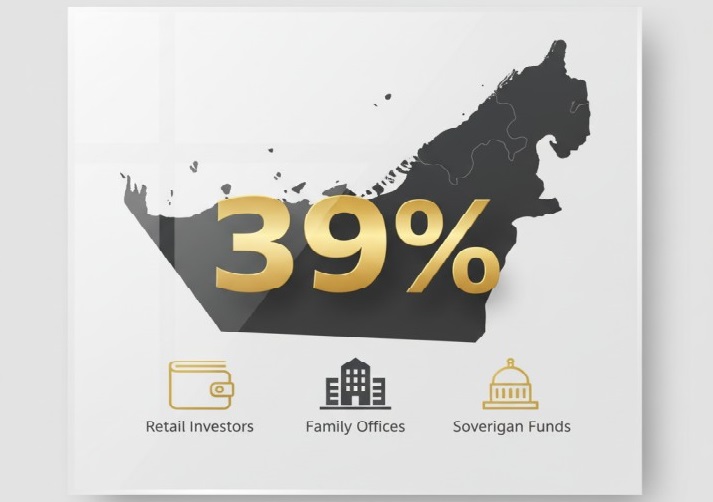
UAE crypto adoption has accelerated dramatically in recent years, driven by a perfect storm of booming markets, regulatory clarity, and a tech-savvy elite. According to a recent Avaloq survey, 39% of high-net-worth (HNW) investors in the UAE now hold digital assets t.signalplus.com – far higher than global averages. Dubai’s ultra-rich, family offices, and even government-linked funds are actively embracing crypto as a new asset class. In fact, the UAE is “quickly becoming one of the world’s hottest crypto hubs,” with Dubai offering a clear regulatory framework through the Virtual Assets Regulatory Authority (VARA) coindesk.com. This blog explores how and why UAE crypto adoption is surging among the wealthy, Dubai’s emergence as a global crypto hub, and what it means for the region’s financial future.
High Crypto Adoption Among Wealthy UAE Investors
Emirati HNW individuals are among the world’s most crypto-confident investors. A survey of 3,851 UAE investors by Swiss fintech firm Avaloq found that 39% of wealthy UAE clients already hold cryptocurrency t.signalplus.com – a staggering figure compared to other markets. Only about one in five of those crypto investors use traditional banks or wealth managers to handle these holdings t.signalplus.com, reflecting a DIY attitude. In practical terms, many wealthy Emiratis are “going all in” on digital assets, educating themselves and turning to crypto-native platforms instead of legacy institutions.
Why such enthusiasm? Lower taxes and higher risk appetite play a role, but so does generational change. Younger scions of rich families are often the crypto evangelists, bringing their elders into the fold coindesk.com. As CoinDesk reports, even “the kids of ultra-high-net-worth families are educating their elders about crypto” coindesk.com. These Millennials and Gen-Z heirs see Bitcoin and blockchain tech as modern store-of-value assets, much like gold once was. According to Avaloq’s UAE snapshot, 63% of wealthy investors are switching or considering switching wealth managers because their current advisors can’t meet crypto demands coindesk.com. In other words, crypto interest among UAE HNWIs is so strong that it is forcing even conservative private banks to adapt.
The trend shows in data from global wealth surveys. Indeed, Standard Chartered’s “Great Repositioning” report found that 71% of UAE ultra-high-net-worth families want to invest in digital assets (cryptocurrencies, NFTs, tokenized assets), versus 69% globally arabianbusiness.com. Moreover, UAE family offices “see digital assets and AI not as speculative tools, but as integral components of a more connected, efficient and resilient wealth ecosystem” arabianbusiness.com. This speaks to a broader mindset: crypto is viewed as a strategic asset class, not a fad.
A Quick Stat Summary of UAE Crypto Adoption
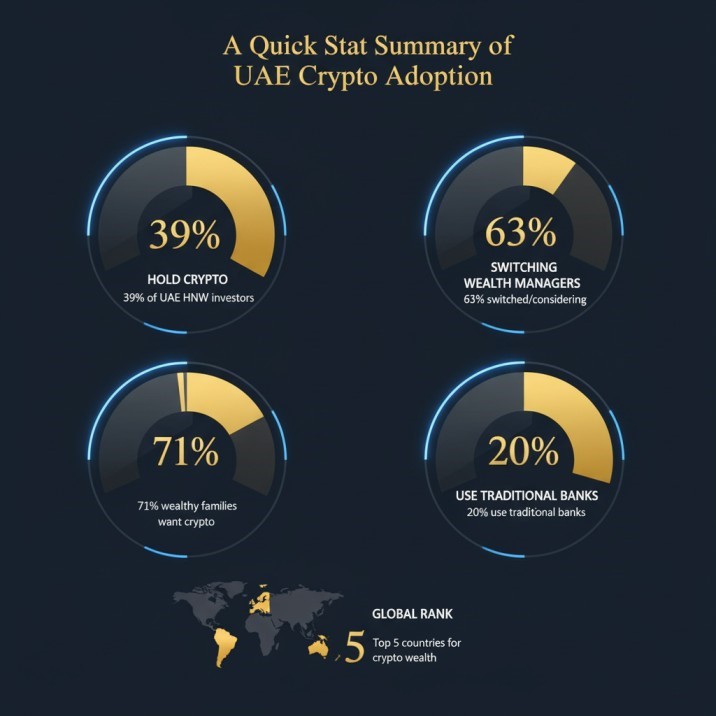
- 39% of UAE HNW investors hold cryptocurrency t.signalplus.com.
- 63% of those investors have switched or are considering new wealth managers over crypto questions coindesk.com.
- 71% of UAE wealthy families want crypto in their portfolios arabianbusiness.com.
- 20% of UAE crypto holders use traditional private banks (the rest use exchanges or specialists) t.signalplus.com.
- Top 5 countries for crypto wealth include the UAE t.signalplus.com.
These numbers reflect rapid UAE crypto adoption among elites, driven by both wealth preservation goals and speculative opportunity.
Dubai: From Oil Hub to Crypto Capital
Dubai’s rise as a crypto hub is no accident. In fact, city leaders have long pushed a “tech-forward” agenda, and Web3 is central to that vision. In the words of a recent GlobeNewswire report, “Dubai’s Web3 momentum is no longer a whisper, it’s a global signal… [emerging] as the nexus where policy, capital, and innovation come together” globenewswire.com. In practice, this means ultra-friendly regulations, tax advantages, and major conferences that attract founders, investors and policymakers worldwide. For example, the Unchained Summit (April 2025) showcased how Dubai is “designing the future of Web3 at pace,” bringing together giants like PayPal, OKX, Binance and Matrixport with local regulators on one stage coindesk.com. Dubai was even chosen to host Binance’s “Blockchain Week” and OKX’s glamorous launch gala, which signals that the world’s biggest crypto firms consider it a strategic hub.
Leadership’s vision is clear. Sheikh Maktoum bin Mohammed, Deputy Ruler and Minister of Finance, announced in Oct 2025 a new Dubai Financial Sector Strategy that puts virtual assets at its core thenationalnews.com. The plan aims to double the financial sector’s GDP share by 2035, with at least 3% of GDP coming from digital assets (up from 0.5% today) thenationalnews.com. Dubai’s Virtual Assets Regulatory Authority (VARA) reports roughly AED 2.5 trillion in crypto transaction volume in 2025 alone thenationalnews.com. More than 40 crypto firms are now licensed by VARA, and hundreds more offer blockchain services in Dubai. Sheikh Maktoum said boosting digital assets is a “key plank” of Dubai’s vision, creating “promising opportunities for investors” thenationalnews.com.
The UAE’s National Digital Asset Strategy (2025) created pathways for tokenized securities and institutional DeFi pilots (source: Unchained Summit press). It also positioned the UAE among the world’s top 5 jurisdictions for crypto wealth t.signalplus.com. Globally, Dubai is now routinely compared to crypto leaders like Singapore and Switzerland. Indeed, the Henley & Partners Crypto Wealth Report ranked the UAE alongside those powerhouses as a leading “crypto country” t.signalplus.com. Such recognition underscores that Dubai is not just participating in the crypto revolution – it’s directing traffic globenewswire.com.
Family Offices and the Young Guard Leading Crypto Adoption
Much of UAE crypto adoption is driven by family offices and intergenerational dynamics. Specifically, ultra-rich Emirati families manage vast fortunes, and many have set up dedicated family offices. According to research by Standard Chartered, UAE family offices are among the world’s most forward-looking: 71% believe they should invest in digital assets as part of their strategy arabianbusiness.com. They combine “vision and discipline,” seeing crypto as a complement to traditional finance arabianbusiness.com. Younger family members – those inheriting generational wealth – often push these initiatives, insisting on blockchain education and digital diversification. In fact, more than two-thirds of UAE family offices report active involvement of heirs in investment decisions arabianbusiness.com. This intergenerational engagement is reshaping wealth management: moreover, grandchildren of oil tycoons are learning wallets and staking right alongside their elders.

Family offices also benefit from Dubai’s ecosystem. Programs like the Dubai Blockchain Center (launched by Sheikh Mohammed in 2018) provide mentorship, research and startup labs for blockchain entrepreneurs blockchaincenter.ae. Numerous accelerators and VC funds (e.g. Cypher Capital, Global Ventures) are actively backing local crypto startups. For example, Dubai-based Byzanlink (focused on tokenizing real-world assets) raised $1 million in 2025 to build its platform phemex.com. Rekt Studios, a gaming metaverse startup, raised $1.5M from Dubai VCs in 2022 waya.media. These successes signal that UAE family offices are not just passively holding Bitcoin – they are reinvesting crypto profits into local innovation.
Government Strategy and Regulatory Clarity
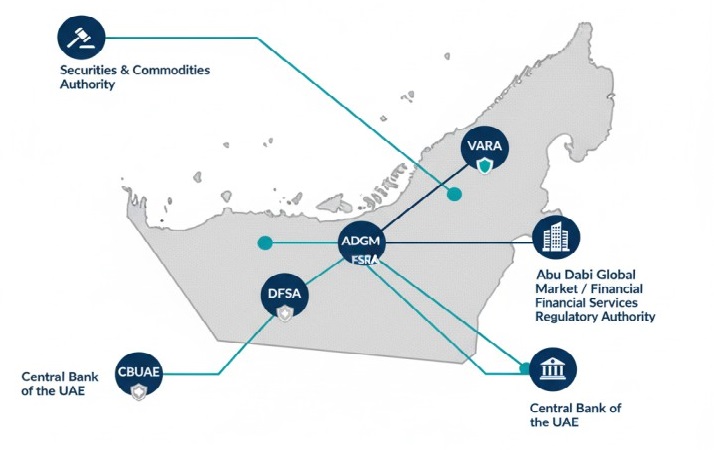
Effective regulation is a major reason why wealthy UAE investors feel comfortable with crypto. Dubai and Abu Dhabi have each established clear, enforceable frameworks to foster digital assets, balancing innovation with safety.
Dubai/VARA
- In 2022, Dubai passed Law No. 4/2022 and created the Virtual Assets Regulatory Authority (VARA). VARA’s 2023 rulebook (the Virtual Asset Framework) licenses Virtual Asset Service Providers (VASPs) for trading, custody, brokerage, wallets, and token issuance legalnodes.com. A 2024 cooperation agreement means any VASP targeting Dubai must have a VARA license (which then registers with federal SCA) dlapiper.com. In practice, major exchanges now operate under VARA oversight: for example, BitOasis (a Dubai-founded exchange) secured a full VASP license thefintechtimes.com, and global players like Binance and OKX obtained Dubai licenses in 2024–2025 binance.com. VARA even enforces regulations: it has shut down unlicensed crypto operators to protect investors (as OKX’s launch article notes) thefintechtimes.com.
Abu Dhabi/FSRA
- Abu Dhabi Global Market (ADGM) enacted a bespoke crypto framework as early as 2018. ADGM’s Financial Services Regulatory Authority (FSRA) licenses exchanges, custodians, brokers, and fund managers in the free zone legalnodes.com. The FSRA has been proactive, running RegLab sandboxes and issuing many licenses to startups. In 2025, Abu Dhabi even launched a bond tokenization platform. Wealthy UAE investors benefit from this by being able to buy digital assets via licensed local venues.
DIFC/DFSA
- The Dubai International Financial Centre (DIFC) uses its own regulator, the Dubai Financial Services Authority (DFSA), for crypto activities within the free zone legalnodes.com. DIFC has approved a number of crypto-related licenses (e.g. crypto trading platforms and funds) under DFSA rules.
Federal/SCA
- On the federal level, the Securities & Commodities Authority (SCA) oversees “virtual assets” as part of Cabinet Decision No. 111 of 2021 dlapiper.com. The SCA delegated crypto oversight to VARA (2022) for Dubai, but retains authority in other Emirates. Recently (Sep 2024), the SCA and VARA made a joint agreement: VARA-licensed firms are automatically UAE-registered, and firms targeting other Emirates must license with SCA dlapiper.com. In Oct 2025, Bybit became the first global exchange to secure an SCA mainland license, enabling it to operate across the UAE coindesk.com.
Central Bank
- The UAE Central Bank regulates crypto-related payments and stablecoins. For instance, Crypto.com recently won a stored value facility license from the Central Bank, allowing it to process UAE government payments in crypto complyfactor.com. Meanwhile, the Central Bank and Saudi central bank have been researching a joint digital currency (Project Aber) – a sign that digital assets are on the national agenda.
In summary, the UAE’s multi-tiered regulatory system gives institutional comfort to crypto businesses and investors. A Dubai consultant noted that licensed crypto firms must meet strict KYC, capital and technology standards legalnodes.com. These layers of oversight — VARA, SCA, FSRA, DFSA, CBUAE — ensure “strong governance and forward-looking innovation” in the UAE’s crypto hub arabianbusiness.com. This clarity is rare: many regions still lack comprehensive crypto laws. In contrast, the UAE has made crypto legality unambiguous, which helps attract billionaires and global firms.
The Landscape of Regulators
| Authority | Jurisdiction | Crypto Role |
|---|---|---|
| SCA (Securities & Commodities Authority) | UAE Mainland (Federal) | Oversees virtual assets via Cabinet Decision 111/2021 dlapiper.com. Delegated Dubai VASP licensing to VARA (2022). Issues federal licenses (e.g. Bybit’s SCA license) coindesk.com. |
| VARA (Virtual Assets Reg. Authority) | Dubai Onshore (Law 4/2022) | Licenses and regulates VASPs (exchanges, wallets, custody, broker-dealers) in Dubai legalnodes.com. Enforces AML/KYC and tech standards. Part of UAE’s Virtual Asset Framework (2023). |
| DFSA (Dubai Financial Services Authority) | DIFC Free Zone | Grants crypto licenses (trading, custody, funds) within DIFC. Operates independently of VARA with its own rulebook. |
| FSRA (Fin. Serv. Reg. Auth.) | ADGM Free Zone | Pioneered crypto law (2018). Regulates exchanges, custodians, token issuers in ADGM. Runs RegLab innovation programs. |
| CBUAE (Central Bank of UAE) | UAE Federal | Regulates stablecoins and digital payment assets. Granting e-dirham (CBDC) pilot and overseeing SVF licenses (e.g. Crypto.com’s UAE license). |
The coherent framework is a magnet: CoinDesk notes that Dubai’s clear crypto laws are a competitive advantage for attracting capital coindesk.com. This aligns with a global trend: cities that clarify regulations early tend to capture crypto businesses (see Switzerland, Singapore, etc. in Henley report t.signalplus.com). Dubai’s gamble on crypto is paying off, turning the emirate into a “living laboratory” for decentralized finance globenewswire.com.
Crypto Platforms, Exchanges, and Startups Flourish
The UAE’s infrastructure for crypto is building fast. Major global exchanges have opened local hubs, and a host of MENA platforms and startups call Dubai home. Among licensed exchanges: Binance Dubai (VARA license issued 2024) and OKX UAE (licensed in 2024) now offer hundreds of coins with AED trading pairs binance.com. OKX, for example, boasts 280 cryptocurrencies and 480 trading pairs in its UAE launchthefintechtimes.com, allowing UAE investors to buy directly with dirhams. BitOasis, a pioneering UAE-born exchange, got Dubai’s first full VASP license in 2024 thefintechtimes.com, enabling it to expand into institutional custody. Even regulators invest in tech: ADGM’s newly launched digital asset exchange (ADDX) will list tokenized securities.
Beyond exchanges, the UAE now hosts a variety of crypto service platforms:
- Custody and Services: Fireblocks, Ledger, and local fintechs are offering institutional custody solutions in Dubai. SolidusLabs notes VARA’s 2025 rulebook upgrade emphasizes on-chain monitoring, so supervised crypto trading desks are rising.
- Payment and DeFi: UAE fintechs like Sarwa (robo-advisory) and Rain (crypto exchange in Bahrain) explore UAE expansions. The Central Bank’s SVF regime means licensed entities can handle crypto-based payments.
- Blockchain Startups: A vibrant startup scene is emerging under Dubai’s wings. Byzanlink (Dubai) raised $1M for tokenizing real-world assets phemex.com. Stonses launched blockchain memorial NFTs, and Rekt Studios raised $1.5M for a virtual gaming world waya.media. Initiatives like the Dubai Blockchain Center offer incubator programs for such founders blockchaincenter.ae.
Together, these platforms create an ecosystem: specifically, wealthy investors can trade crypto on licensed exchanges, custody assets with institutional-grade security, and even invest in cutting-edge blockchain ventures. The result is a self-reinforcing cycle: more users attract more startups, which in turn develop services tailored to local needs (e.g. Sharia-compliant crypto products).
Navigating Risks and Future Outlook
Of course, crypto still carries volatility and risk. Some UAE investors remain cautious: non-owners cite price swings (38%), lack of knowledge (36%) and exchange trust issues (32%) as concerns t.signalplus.com. Regulators are aware of these risks. VARA has law enforcement powers to fine or suspend non-compliant firms dlapiper.com, and a Grievance Committee for appeals, reflecting a commitment to investor protection. The Central Bank is exploring how to manage volatility through liquidity and transparency requirements.
For now, the net effect is decidedly positive. Avaloq’s analysis suggests that regulatory clarity and institutional adoption should support crypto prices in the long term t.signalplus.com. In Dubai, crypto transactions are already in the trillions of dirhams, yet contribute only 0.5% of GDP thenationalnews.com – meaning the sector has room to grow. As Sheikh Maktoum said, the new strategy will bolster investor confidence and cement Dubai’s status as a “premier destination” for financial innovation thenationalnews.com.
Key Takeaways: Wealthy UAE investors are embracing crypto like never before, driven by favorable regulation, generational shifts, and global market momentum. Ultimately, Dubai’s government and regulators have made digital assets a strategic priority, turning the emirate into a world-class crypto hub. Licensed exchanges (Binance, OKX, BitOasis, Bybit, etc.), blockchain startups, and family offices all fuel this ecosystem. The result: “crypto is the new currency of the elite” in the UAE, from personal portfolios to government vision.
UAE Crypto Regulatory Landscape
| Authority | Scope | Crypto Mandate |
|---|---|---|
| SCA (Securities & Commodities Authority) | UAE Federal (mainland) | Oversees virtual assets under Cabinet Decision 111/2021 dlapiper.com; delegated Dubai VASP licensing to VARA (2022) dlapiper.com; issues nationwide licenses (Bybit is first SCA-licensed exchange coindesk.com). |
| VARA (Virtual Assets Regulatory Authority) | Dubai (Onshore) | Created by Dubai Law 4/2022, VARA licenses and regulates crypto firms (exchanges, brokers, custody, etc.) dlapiper.com. Its 2023 rulebook defines VASP categories and AML/KYC standards. |
| DFSA (Dubai Financial Services Authority) | DIFC free zone | Independent regulator for DIFC; issues crypto licenses within DIFC (separate from VARA). Tailored to financial free zone operations. |
| FSRA (Financial Services Regulator) | ADGM free zone | First to adopt crypto law (2018); licenses exchanges, custodians, advisers in ADGM dlapiper.com. Offers fintech sandboxes (RegLab, Digital Lab). |
| CBUAE (Central Bank) | UAE Federal | Regulates crypto-related payments and stablecoins. Piloting CBDC (e-dirham) with Saudi, overseeing stored-value facilities (Crypto.com got UAE SVF license). |
Conclusion
The UAE’s story is clear: UAE crypto adoption is surging across individual wealth, family offices, and the public sector. As a result Dubai’s strategic bet on crypto has made it a beacon for investors and entrepreneurs worldwide. For wealthy individuals, crypto is no longer a fringe idea but an established asset class supported by rigorous laws.
What about you? Are you exploring crypto investments or blockchain projects? Share your thoughts on Dubai’s crypto journey in the comments. If you’re in the UAE, consider attending a local crypto meetup or summit – stay ahead in this fast-moving space.
Don’t let the learning stop here! Dive into our other articles (Binance Return to US, US/China Tariff War and Bitcoin halving Explain) and keep exploring the future of finance.



Pingback: US Government Shutdown Ends: What It Means for Crypto - tokensbuzz.com