

Changpeng “CZ” Zhao, Binance’s founder, has been thrust back into the spotlight. President Trump’s October 2025 pardon of Zhao – the convicted Binance CEO – has reignited talk of “Binance return to the US market.” Trump’s statement and a supportive White House have signaled a new, crypto-friendly era. A White House spokesperson even declared that the “war on crypto is over” theguardian.com. Zhao himself thanked Trump and vowed to “do everything we can to help make America the Capital of Crypto” reuters.com. Almost immediately, Binance’s native token (BNB) jumped ~8% cryptonews.com and the broader crypto market rallied, reflecting renewed investor optimism. In this analysis, we explore what Binance’s potential US comeback means for the exchange landscape and what regulatory hurdles still loom. The focus keyword “Binance return to the US” appears frequently here, underscoring its SEO importance.
Trump’s Crypto-Friendly Agenda and the Pardon
Since returning to office, President Trump has signaled strong support for cryptocurrencies. He has pardoned several high-profile crypto figures (e.g. BitMEX co-founders, Silk Road’s Ross Ulbricht) and tapped crypto advocates into key roles (such as nominating CFTC crypto-expert Mike Selig reuters.com). White House press secretary Karoline Leavitt criticized the prior administration’s “war on cryptocurrency” and said Trump aimed to “correct [that] overreach”apnews.com. In this context, pardoning Binance’s CZ fits Trump’s pledge to be a “crypto president” and to make the U.S. a crypto capital apnews.com.
The pardon itself was sweeping. It fully restored Zhao’s rights, wiping away his 2024 conviction for violating U.S. anti-money laundering laws guardian.com. Trump commented that many people believed Zhao “wasn’t guilty of anything” and that Biden’s prosecutors had been “very hostile to the crypto industry” apnews.com. Republican and crypto circles see this as vindication – a chance to “end the crackdown” on digital assets. Indeed, Zhao issued a statement saying he was “deeply grateful” and emphasizing innovation and fairness apnews.com. Binance thanked the administration for its leadership.
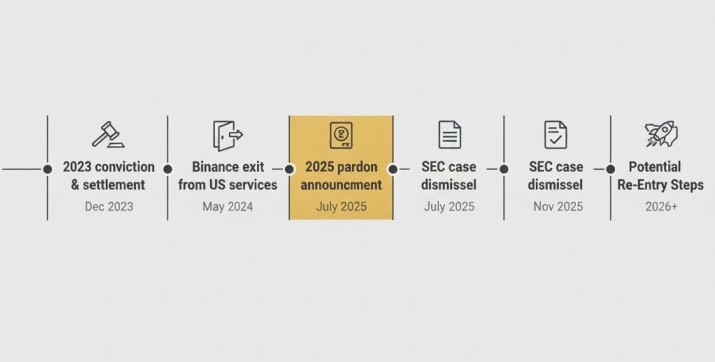
This change of tone has already led to concrete policy shifts. Under Trump’s administration, the SEC voluntarily dismissed its 2023 lawsuit against Binance and Zhao with prejudice reuters.com. In a joint court stipulation, the SEC said it would not pursue the case further. Binance hailed this as a “landmark moment,” crediting SEC Chairman Paul Atkins and the Trump White House reuters.com. Likewise, Congress and regulators have been moving toward clearer crypto rules (e.g. the “GENIUS” and “CLARITY” acts) that investors have welcomed reuters.com. In short, the political wind is blowing Binance’s way – at least on paper.
What a Binance Return to the US Could Look Like
In practical terms, Binance return to the US market could take several forms. Right now, the U.S. affiliate Binance.US operates as a separate, limited platform. It offers far fewer coins and services, and it captures <1% of U.S. Bitcoin trading volume cryptonews.com. By contrast, Binance’s global exchange commands ~40% of worldwide volume. The Bloomberg report cited by CryptoNews suggests Binance is exploring how to consolidate its U.S. arm with its main exchange or otherwise serve American customers directly cryptonews.com. In other words, Binance might integrate Binance.US back into its global ecosystem or lift the market restrictions on U.S. users – effectively re-entering the U.S. market.
For U.S. investors, this could mean access to Binance’s deep liquidity, low fees, and broad services (like margin and derivatives) that were previously off-limits. As one crypto analyst noted, we may see Binance.US “reintegration” that gives U.S. traders “direct access to the platform’s deep liquidity and comprehensive derivatives offerings” cryptonews.com. In practice, this could spur competition with current U.S. champions (Coinbase, Kraken, etc.) and potentially drive prices up for altcoins and tokens normally only traded on Binance. Indeed, industry media already reports that Binance has contacted Trump’s crypto venture (World Liberty) about taking a stake in its U.S. operations (per WSJ). A sign Binance is laying groundwork for U.S. growth theguardian.com.
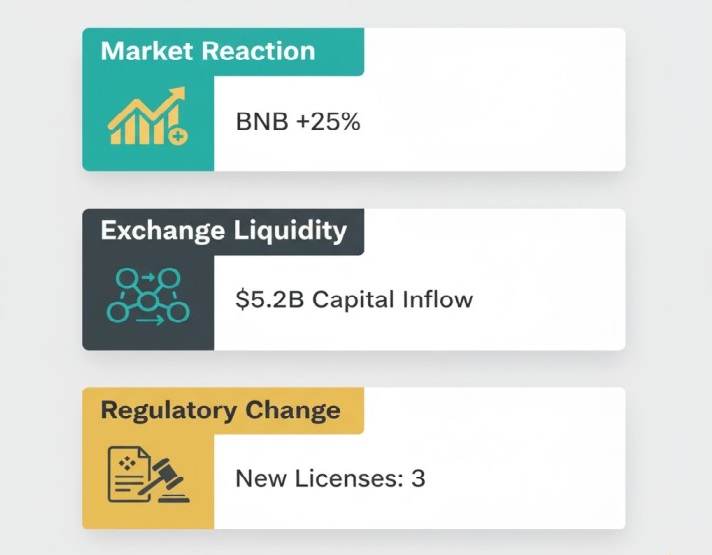
Meanwhile, the crypto market itself has been buoyant. Bitcoin and other majors rose modestly on the pardon news (The Motley Fool reported Bitcoin +3.5%, Ethereum +5% in the week after) nasdaq.com. Binance’s BNB token surged nearly 8%. This reflects broader investor confidence. If Binance returns, U.S. traders could flood back to crypto, and institutional products (ETFs, futures) might expand. A recent Nasdaq/Motley Fool piece even speculated that the pardon could “pave the way for Binance to once again make the U.S. its key base of operations” nasdaq.com. Potentially becoming a bullish catalyst for 2026 crypto prices.
Comparison of Major Crypto Exchanges (US Status)
| Exchange | US Access (2025) | Notes/Regulatory Status |
|---|---|---|
| Binance (global) | No direct US operations | Banned from US retail; must abide by FinCEN/DOJ exit requirements home.treasury.gov. |
| Binance.US | Yes – limited | Separate entity with strict compliance. Offers fewer assets and features; <1% US volume cryptonews.com. |
| Coinbase | Yes – fully available | Leading US exchange; regulated (SEC/CFTC). Trusted “safe” platform. |
| Kraken | Yes – fully available | Longstanding US presence; strong regulatory compliance (New York DFS, etc.). |
| Gemini | Yes – fully available | Regulated by New York DFS. Founded by Winklevoss twins. |
| Crypto.com | Yes | Licensed in US jurisdictions (NYDFS, etc.); expanding products. |
This table highlights that Binance (global) is the odd one out – it must remain offshore by current law home.treasury.gov, while its peers legally serve Americans. Any true “Binance return to the US” would have to navigate or renegotiate those legal barriers.
Expert and Investor Perspectives
Crypto insiders and analysts are divided on what happens next. Markus Thielen (10x Research) believes Binance can leverage institutional demand. He predicts Binance.US will likely be “reintegrated into the global Binance ecosystem,” giving U.S. investors much deeper liquidity and products cryptonews.com. Likewise, Patrick Horsman (Applied DNA Sciences CIO) argued that Binance’s technology, liquidity, and low fees would make it “a dominant powerhouse in the American crypto market” once it’s allowed back. On the other hand, Coinbase and other U.S. exchanges may not give ground easily. Owen Lau of Clear Street noted that Coinbase enjoys a first-mover “trusted platform” advantage domestically cryptonews.com. A strong brand and compliance record that new entrants must overcome.
Investors on social media have expressed a mix of optimism and caution. One crypto fund manager told Forbes (via Axios) that the pardon “could accelerate Binance return to U.S. compliance talks” and “rekindle institutional participation.” Others point out that Zhao still owns most of Binance, so its strategic direction matters. In The Verge, tech journalist Liz Lopatto reminded readers that Zhao had been barred for 3 years from any Binance business after his conviction theverge.com. She queried whether the pardon frees him from those restrictions. Noting “I imagine this guy… wants to run his company” theverge.com. If Zhao does resume a leadership role, Binance could move much faster to re-open U.S. services (either through its affiliate or a rebranded unit).
Meanwhile, some investors recall lessons from the past. Many remember how Coinbase surged after winning SEC registrations that Binance lacked. They warn that regulatory scrutiny could bite Binance again. A senior crypto trader commented in crypto-media interviews: “The market loves Binance back, but it’s not a free pass. They still have to play by U.S. rules.” In fact, Binance itself has said it will “operate with the respect to law and regulatory requirements” as it expands cryptonews.com.
Regulatory Hurdles Still Ahead
Despite the positive momentum, significant regulatory challenges remain. First and foremost, Binance’s 2023 DOJ/Treasury settlement explicitly forced the exchange out of the U.S. The settlement included a monitorship and compliance requirements “to ensure Binance fulfils the terms… including that it does not offer services to U.S. persons” home.treasury.gov. In other words, by law Binance must currently exit the U.S. Completely reversing this would require renegotiating the deal or strict oversight to allow a re-entry.
Another hurdle is the compliance burden. U.S. regulators will demand airtight controls on anti-money laundering and sanctions. Treasury Secretary Yellen warned that Binance “turned a blind eye” to illicit flows home.treasury.gov, so any comeback must come with extreme caution. The settlements imposed hefty fines and a five-year monitorship to enforce compliance home.treasury.gov. If Binance tries to return too quickly, it could violate those terms and incur new penalties.
Legislatively, Congress remains concerned. Some lawmakers have already introduced new bills targeting crypto executives and stablecoins. For example, Senator Elizabeth Warren blasted the pardon and warned of “urgent concerns regarding the integrity of our justice system” cryptonews.com. Rep. Maxine Waters likewise called out the pardon as “effectively legitimiz[ing] the crypto crime CZ was convicted of” cryptonews.com. Even friendly administrations don’t control Congress: bipartisan groups like the President’s Working Group on Financial Markets (PWG) have recommended stronger stablecoin rules and consumer protections. The new “American Crypto Act” and other proposals could reshape exchanges’ rules on custody and transparency.
There are also tax and securities issues. If Binance returns, it must comply with IRS reporting and potentially with SEC or CFTC oversight of digital assets (depending on how coins are classified). Trump’s administration has shown a preference for CFTC jurisdiction (Chair Selig vows to help make the U.S. the “crypto capital” reuters.com), but the SEC still plays a big role. Notably, the SEC’s case against Binance was dropped, but that was a policy change, not a law. Future administrations or a split Congress could revive tougher enforcement.
In sum, even with the pardon, Binance’s pathway is not smooth. It will need to rebuild trust with regulators and possibly operate under new charters. Some industry observers point out that Binance.US – currently run by CEO Yi He and board lead Brian Brooks – might serve as a template. As one analyst put it, Binance could “consolidate [its] U.S. affiliate into the global platform or enable direct U.S. market access” cryptonews.com. But any expansion will likely require new charters or licenses. For example, Binance.US would need to meet all U.S. licensing for securities trading if it starts listing tokens the SEC deems securities.
Charting the Path Forward
The pardon has cleared a key political roadblock for Binance’s US ambitions, but significant legal and regulatory roadblocks remain. In the near term, investors should watch for Binance’s formal plans. Will it ask regulators for licenses? Will it make deals (as with World Liberty) to bolster U.S. presence? Or will Coinbase and others gear up competition? Industry insiders expect Binance.US to ramp up hiring and product offerings to capture more market share cryptonews.com.
For now, crypto markets appear buoyed. Traders and analysts interviewed in recent news noted that Trump’s “crypto-friendly” stance and the CZ pardon have lifted sentiment nasdaq.com. Longtime Binance watcher Mark Bini (White Collar defense attorney) said the pardon “is not very surprising” for such a high-profile industry figure apnews.com. Others, like Reuters reporters, think it could allow Binance to “expand in the United States as the crypto industry booms under the Trump administration” reuters.com.
Ultimately, whether Binance truly reclaims a central role in the U.S. market depends on balancing opportunity with oversight. Its CEO’s newfound freedom could reintegrate him into strategic decisions, possibly lifting the self-imposed exile. But any moves will be watched by regulators and lawmakers. As one crypto fund manager remarked, “CZ’s freedom is only half the story. The other half is whether Binance can now operate on America’s terms.”
The crypto industry is at a crossroads. Will Binance return to US spur innovation and competition, or will new rules slow it down? We invite readers to share thoughts: Are you excited or skeptical about Binance coming back? Do you think U.S. regulators will bend or harden? Comment below and let’s keep



Pingback: UAE Crypto Adoption: Dubai’s Wealthy Embrace Digital Assets - tokensbuzz.com