


Imagine spotting a hot new DeFi opportunity… only to realize you don’t have the right token on the right chain. That scenario is all too common in today’s multichain crypto world across.to. A crypto bridge fixes this by acting as your gateway between networks: it lets you lock or swap an asset on one blockchain and retrieve the equivalent on another chain. In simple terms, a crypto (or blockchain) bridge is a tool that lets you port assets from one blockchain to another, solving the core problem of blockchain interoperability coindesk.com. By connecting isolated networks, bridges open up new liquidity and DeFi opportunities across chains – but they also bring unique risks.
Cross-chain bridges link previously isolated networks, allowing tokens to flow freely between them. As one expert puts it, bridges are “like translators between different networks,” enabling you to transfer crypto assets from one blockchain to another blog.bitunix.com. For example, you could lock ETH on Ethereum and mint a wrapped ETH on Avalanche, then burn it to redeem the original ETH – all handled by the bridge’s smart contracts. This process unlocks “multi-chain DeFi” and cross-chain DeFi apps that otherwise couldn’t function. In fact, bridges have become the gateway to a multichain crypto ecosystem, letting users access low-fee networks, unique yield platforms, and NFT marketplaces on any chain chainalysis.com.
What Is a Crypto Bridge?
A crypto bridge (also called a cross-chain or blockchain bridge) is essentially a protocol or smart contract system that connects two otherwise incompatible blockchains coindesk.com. Bridges work by securely locking or burning tokens on the source chain and then minting or releasing matching tokens on the destination chain. In a typical lock-and-mint bridge, you send (lock) your tokens to the bridge contract on Chain A, which then verifies this action and mints an equivalent “wrapped” token on Chain B. When you’re done, you send the wrapped token back to the bridge on Chain B (burn it), which signals the bridge to unlock your original asset on Chain A chainalysis.com. This two-way mechanism lets you effectively “move” assets without centralized exchanges – the bridge itself holds custody until you reverse the process.
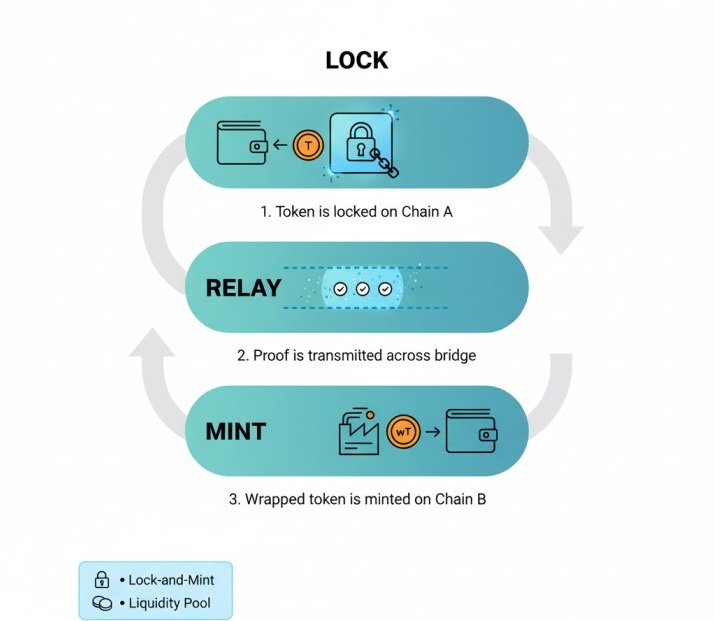
What makes cross-chain bridges (crypto bridge) powerful is that they do this trustlessly, without a single custodian. Instead of relying on a central middleman, many bridges use distributed networks of validators or smart contracts on each chain to verify transfers unchainedcrypto.com. For example, modern bridges like Wormhole use a set of validator nodes (“Guardians”) that observe events on one chain and certify them on another. Once enough validators sign a transfer (e.g. 13 out of 19), the bridge knows the lock on the source chain is valid and releases funds on the target chain. This design – often called non-custodial or trust-minimized bridging – means you keep control of your funds via smart contracts. The bridge’s code enforces that tokens on one side always match the tokens on the other.
Custodial or non-custodial Crypto Bridges
Bridges can also be custodial or non-custodial. Custodial bridges (like wrapped Bitcoin by BitGo) hold your assets centrally and issue pegged tokens; you must trust the custodian. Non-custodial bridges rely on smart contracts and decentralized consensus chainalysis.com. Either way, the goal is the same: move value across chains while preserving a 1:1 peg. In practice, some bridges use a mix of methods (lock-and-mint, burn-and-mint, liquidity pools, etc.) to optimize for speed or liquidity across.to. The bottom line: a crypto bridge unlocks assets from one blockchain so they can be used on another, enabling true cross-chain interoperability.
Why Bridges Matter for Crypto Users
Cross-chain bridges are more than a convenience – they’re the connective tissue of a multi-blockchain future chainalysis.com. Without bridges, each blockchain is its own “island” of liquidity and applications blog.bitunix.com. Bridges break down these walls: they let you tap into the strengths of each network. For example:
- Expanded DeFi opportunities. By moving tokens between chains, users can chase yields on multiple networks. If you have Ethereum-based DAI but want to farm on Avalanche or Polygon, a bridge transfers your DAI instantly to that ecosystem blog.bitunix.com. Curve, Aave, and many protocols rely on bridges to move liquidity across chains.
- Multi-chain DApps. Developers can build dApps that operate on multiple chains. Bridges allow a game token or NFT minted on one chain to be used on another chain’s version of the game or marketplace. This interoperability enriches user choice.
- Lower costs & speed. Bridges let users leverage cheaper networks. For example, you might bridge your assets to a high-throughput sidechain for cheap transactions. Many users lock funds on Ethereum and withdraw an equivalent on a rollup or sidechain to avoid high gas fees.
- Connecting ecosystems. Bridges enable features like cross-chain atomic swaps and messaging, making a more unified crypto experience. You might even move assets to a chain optimized for NFT marketplaces or gaming that suits your needs.
According to Chainalysis, bridges are indeed “the connective tissue that allow different blockchains to securely share data and assets”. The demand is immense: 2024 saw monthly cross-chain volume fluctuating between roughly $1.5 and $3.2 billion chainalysis.com. As shown below, cumulative bridge activity peaked during the boom of late 2021 and has settled into the low-billion range monthly in 2024 – a testament to how actively traders and builders rely on bridges. The chart illustrates these flows over time (Chainalysis data):
Data from Chainalysis shows that cross-chain bridging is used at scale. In 2024, monthly bridged volume consistently stayed in the low billions (USD) chainalysis.com. The peaks in 2021–2022 reflect rapid DeFi expansion, but even during 2024’s scaling period, users regularly moved over $1.5B each month. This illustrates that cross-chain demand is not going away.
In short, crypto bridges make the entire blockchain ecosystem more flexible. They “unlock new opportunities for providing liquidity, accessing DApps on other networks, and diversifying strategies across chains” blog.bitunix.com. Without them, you’d be confined to whatever chain your assets started on.
How to Use a Crypto Bridge: Step-by-Step
Using a crypto bridge may sound technical, but with a good guide and a little care, it’s straightforward. Here’s a general step-by-step process that works for most bridges:
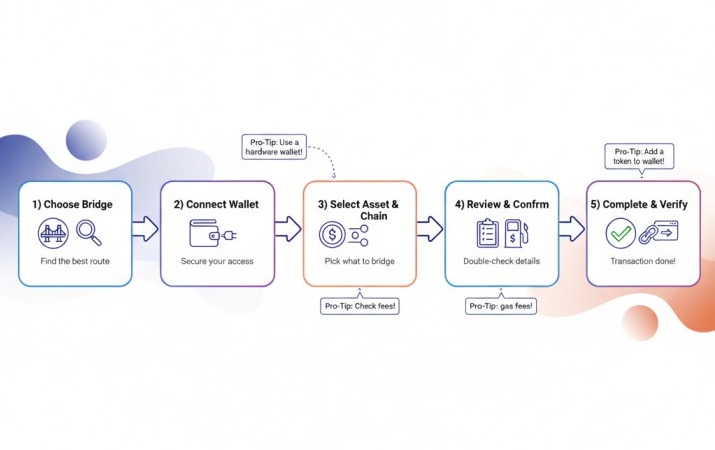
- Choose a bridge. Pick a reputable bridge that supports your source and destination chains as well as your asset across.to. For example, if you want to move USDC from Ethereum to Polygon, ensure the bridge has liquidity and support for USDC on both chains. When evaluating bridges, consider security, speed, and cost across.to. Look for trust-minimized or audited protocols. Keep an eye on fees – some bridges add extra service fees, and gas costs can vary widely between chains.
- Connect your crypto wallet. Most bridges are accessed via a web interface or DApp. Click “Connect Wallet” and choose your wallet (MetaMask, WalletConnect, Phantom, etc.) across.to. Make sure your wallet is set to the source chain (the one you’re bridging from). For example, if sending from Ethereum, your wallet network should be Ethereum Mainnet when connecting. Confirm any prompts to allow the bridge to read your balances.
- Select asset and destination chain. In the bridge UI, pick the token you want to transfer (e.g. ETH, USDC) and choose the target chain (the chain you want to receive on) across.to. The interface will often display estimated fees. Double-check that your chosen token is actually supported on the destination. For instance, native ETH exists on Optimism and Polygon via their own bridges, but if a chain doesn’t natively support ETH, you may need to bridge a stablecoin instead. The guide suggests choosing tokens that are widely supported (like USDC or DAI) to avoid issues across.to. Also think about why you’re bridging – perhaps the destination chain offers lower fees or unique DeFi apps (e.g. Polygon for gaming, Arbitrum for trading) across.to.
- Review fees and confirm. Bridges will show you an estimated transaction fee, which often includes gas fees on the source chain plus any bridge fee. Confirm that you have enough funds to cover gas. Once you’re ready, hit “Send” or “Confirm” in the bridge interface. Your wallet will pop up asking to approve the transaction on the source chain. At this point, the bridge typically locks or burns your tokens on Chain A and begins the process of minting or releasing them on Chain B across.to. If the bridge uses a pooled-liquidity approach (like Stargate or Symbiosis), your asset might be moved through a liquidity pool instead of a wrapped token minting.
- Wait for completion. Bridges can take anywhere from a few seconds to minutes (or sometimes longer if there’s a finality wait). Once the bridge transaction is submitted, your tokens should eventually appear in your wallet on the destination chain. If they don’t show immediately, be patient – it could take some time to finalize. You can switch your wallet’s network to the destination chain to check if the tokens have arrived. If necessary, you may need to manually “add” the token contract to your wallet on the new chain to see the balance. Some bridges also provide a transaction history or link to a block explorer – use that to verify the status. Once confirmed, you’ll see your bridged tokens (or their wrapped equivalent) ready to use on the new chain.
Above all, proceed carefully. Simple mistakes can be costly. Common pitfalls include: choosing the wrong source/destination network, underestimating gas fees, and bridging an unsupported assetacross.toacross.to. Always double-check your settings at each step. Here are a few key tips:
- Double-check the networks. Before confirming, make sure you’re on the right source and target chains. Accidentally sending ETH meant for Polygon over a bridge to Arbitrum, for example, could mean lost fundsacross.to.
- Confirm token compatibility. Not every token exists on every chain. Ensure the asset is supported on the destination. If not, consider bridging a stablecoin or another asset that the destination supports across.to.
- Watch fees. Gas prices can spike, and some bridges add a spread. Check the estimated gas and have a little extra ETH (or native gas coin) in your wallet to avoid being stuck.
- Be patient. Don’t assume instant completion. Some bridges take minutes or longer. If it’s taking time, check a block explorer (e.g. Polygonscan, Arbiscan) to see if your transaction is pending or done across.to.
By following these steps carefully, you can safely move assets across chains. Now let’s look at some of the leading bridges that power this interoperability.
Top Cross-Chain Bridges in 2025
The bridge you choose can make a big difference in cost, speed, and supported assets. Here are some of the most popular cross-chain bridges today:
- Wormhole: A pioneer in cross-chain transfers, Wormhole connects dozens of networks. It uses a Core Bridge contract on each chain, secured by a set of 19 validator nodes unchainedcrypto.com. When you bridge with Wormhole, those nodes watch for your deposit and then mint an equivalent token (like wrapped ETH) on the target chain. Wormhole supports many major blockchains (Ethereum, Solana, BNB Chain, Avalanche, Polygon, etc.) unchainedcrypto.com. It’s known for NFT and token transfers but note that past exploits (a $320M hack in 2022 coindesk.com) show that even big bridges carry risk. Use only audited bridges like Wormhole if you need those specific chains.
- Stargate: Built on top of LayerZero’s messaging, Stargate is an omnichain liquidity protocol. It allows native asset swaps with unified liquidity pools (no wrapping required) nansen.ai. For example, Stargate enables 1:1 swaps of ETH, USDC, USDT, etc., between chains like Ethereum, BNB Chain, Avalanche, Polygon, Arbitrum, Optimism, Fantom, and more nansen.ai. This instant finality design means once you send, the funds are guaranteed delivered (without waiting for a second confirmation). Stargate’s liquidity pools also let you add funds and earn yield as a liquidity provider. Recently upgraded (Stargate V2), it continues expanding to new chains and offers various transfer modes to balance speed and cost nansen.ai. If you need seamless transfers of major assets across EVM chains, Stargate is a top choice.
- Synapse Bridge: Synapse is a multi-chain bridge and AMM network. It supports both EVM and non-EVM chains, making it very versatile 101blockchains.com. Synapse uses a hybrid approach: it offers liquidity-pool swaps for native tokens and an RFQ (request-for-quote) model to find the cheapest path 101blockchains.com. It also handles “canonical token” transfers (i.e., minting wrapped versions) across its network of supported chains. The Synapse bridge has its own security layer: an optimistic fraud-prover system where off-chain validators can challenge fraudulent transfers. The protocol is governed by a DAO (Cortex DAO), giving token holders a say 101blockchains.com. In practice, Synapse excels at routing assets along the best available route for speed and cost. It’s one of the most widely used bridges, with a focus on security and cross-chain liquidity optimization 101blockchains.com.
- Symbiosis: This bridge is unique in being a cross-chain DEX rather than just a simple bridge. It operates as an AMM that lets you swap any token to any other token across chains in one click symbiosis.finance. Under the hood, Symbiosis uses specialized liquidity pools (“Octopools”) that span multiple chains, allowing users to exchange tokens cross-chain seamlessly. It supports over 45 networks (including many Layer-1s and Layer-2s, both EVM and some non-EVM) symbiosis.finance. For example, you could directly swap MATIC on Polygon for UNI on Ethereum via a Symbiosis cross-chain swap in a single transaction. Its innovative use of transit tokens (like USDC or WBTC as bridges) and multi-coin pools aims for low slippage. Symbiosis also offers staking and an on-chain governance token (SIS) for network security symbiosis.finance. Use Symbiosis if you want broad token-to-token swaps without manually bridging two different assets.
Other bridges worth noting include Celer cBridge (fast transfers among EVM chains), Connext (fiat-transfer-style state channels for low fees), Axelar Network (generalized secure messaging for assets), and native chain bridges like Polygon Bridge or Avalanche Bridge for specific ecosystems. Each has its niche. But Wormhole, Stargate, Synapse, and Symbiosis are among the most prominent general-purpose bridges today.
| Bridge | Supported Chains | Key Features |
|---|---|---|
| Wormhole | ~30+ chains including Ethereum, Solana, BNB Chain, Avalanche, Polygon unchainedcrypto.com | Uses a “Core Bridge” with 19 validators; supports fungible tokens & NFTs; trust model: decentralized (Guardians); known for speed and wide coverage unchainedcrypto.com. |
| Stargate | Major EVM chains (Ethereum, Arbitrum, Optimism, Polygon, Avalanche, Fantom, BNB Chain, etc.) nansen.ai | Unified liquidity pools for native assets (no wrapping); instant finality; LayerZero-based messaging; trust model: liquidity pool (no custodial; uses permissioned validators) nansen.ai. |
| Synapse | Many EVM + select non-EVM chains | Hybrid design (liquidity pools + RFQ + canonical token bridging) for cost/speed; optimistic fraud-proofs for security 101blockchains.com; decentralized governance (SYN/CX token) 101blockchains.com. |
| Symbiosis | 45+ chains (L1, L2, EVM+non-EVM) symbiosis.finance | Cross-chain DEX swaps: one-click token-to-token trades across chains; uses multi-coin pools (Octopools) and transit tokens; trust model: validators & on-chain staking; also a network token (SIS) symbiosis.finance. |
| (Others) | Connext, Celer, Axelar, etc. | Specialized bridges: Connext (fast state channels), Celer (EVM swaps), Axelar (cross-chain messaging), etc.; consider these for specific use cases. |
Risks and Best Practices
While crypto bridges unlock incredible possibilities, they come with serious security considerations. Bridges have been prime targets for hackers: According to Chainlink nearly $2.8–$2.9 billion has been stolen via bridge exploits so far across.to. In fact, one study found that about 69% of all crypto stolen in 2022 was taken through bridge hacks blog.bitunix.com. Major breaches like Wormhole ($320M stolen in 2022) coindesk.com, the Ronin exploit ($624M in 2022) chain.link, and Multichain ($125M in 2023) across.to highlight the stakes. In each case, a vulnerability or compromised validator allowed attackers to mint funds or withdraw massive liquidity.
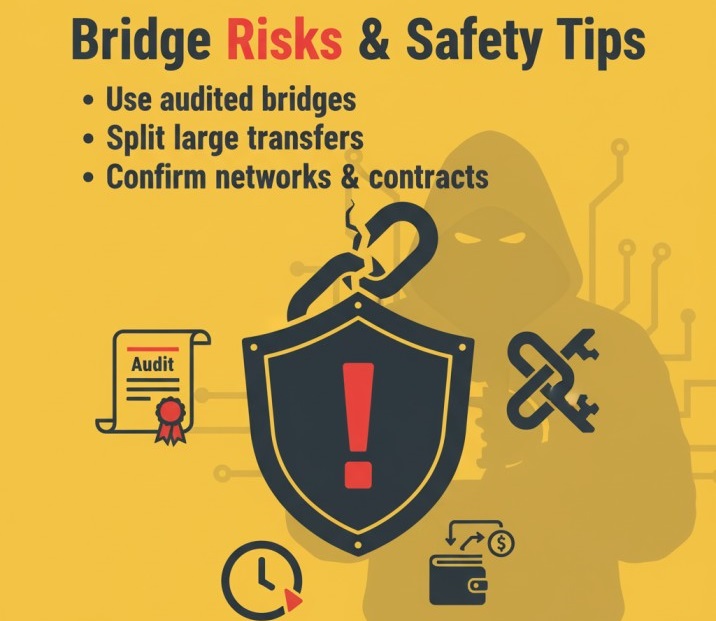
What makes bridges risky? Unlike a single-chain DEX, cross-chain bridges involve multiple smart contracts, message passing, and sometimes centralized validators. A flaw in any part (private key control, contract code, or consensus) can be disastrous across.to. For example, Chainlink warns that any “centralized” bridge becomes a single point of failure chain.link. Conversely, properly decentralized designs can mitigate this.
Best practices: To stay safe, stick with well-known, audited bridges and only the reputable assets. Before bridging, research the bridge’s security model: does it use multi-sig, doxxed validators, or an on-chain fraud proof? Check for recent audits by reputable firms. Whenever possible, use non-custodial bridges that keep your assets in smart contracts rather than giving them to a third party. Also, avoid newly deployed bridges without much track record. Finally, only bridge what you need – holding large balances in bridge contracts (the “honeypot”) is risky across.to. Some users even break transfers into smaller chunks to limit exposure.
By following security best practices and staying informed about bridge reliability, you can mitigate many risks. Remember, centralized bridges and private keys are exactly what many past hacks exploited chain.link. In contrast, newer protocols (like some intent-based designs) aim to eliminate locked funds entirely, shifting risk to competing relayers across.to. This innovation shows the future of bridges: minimizing trust assumptions while keeping the system smooth for users.
Conclusion and Next Steps
Crypto bridges make the decentralized world truly multichain. By following the steps above – choosing a reputable crypto bridge, connecting your wallet, and carefully sending assets – you can transfer tokens between chains just as easily as between bank accounts. We’ve covered the basics of how blockchain bridges work, spotlighted the top cross-chain bridge protocols, and highlighted key safety tips.
Now it’s your turn: what’s the next chain you’ll explore? Share your bridging experiences or questions below. If you found this guide helpful, explore related content Bitcoin Halving, AI & Crypto, DeFi and Wallet security, and consider subscribing for more in-depth crypto tutorials. The future of finance is multi-chain – with bridges, you can be ready to cross any network. Safe travels on the blockchain bridges ahead!




Pingback: How to Bridge Bitcoin? Step-by-Step Guide & Top Platforms - tokensbuzz.com